Aloísio Magalhães: Pioneer of Brazilian Modern Graphic Design
Early Formation and Artistic Foundations Born in Recife on November 5, 1927, Magalhães began his journey in the arts after earning a law degree in 1950.
Early Formation and Artistic Foundations
Born in Recife on November 5, 1927, Magalhães began his journey in the arts after earning a law degree in 1950. Not long after, he embraced theater design and puppetry, reflecting his early interest in visual expression and narrative constructs.
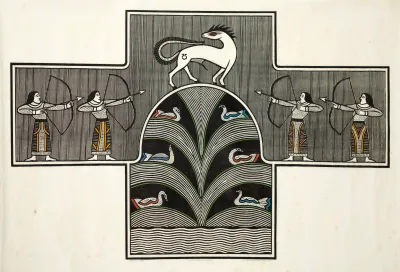
Supported by a French government fellowship, he studied museology and printmaking at Atelier 17 in Paris (1951–53), under the tutelage of Stanley William Hayter. Returning to Recife, he co-founded the avant-garde atelier and publication O Gráfico Amador in 1954, a collective platform where writers, poets, and artists collaborated in handcrafted prints and limited-run publications.

Defining Modern Brazilian Design
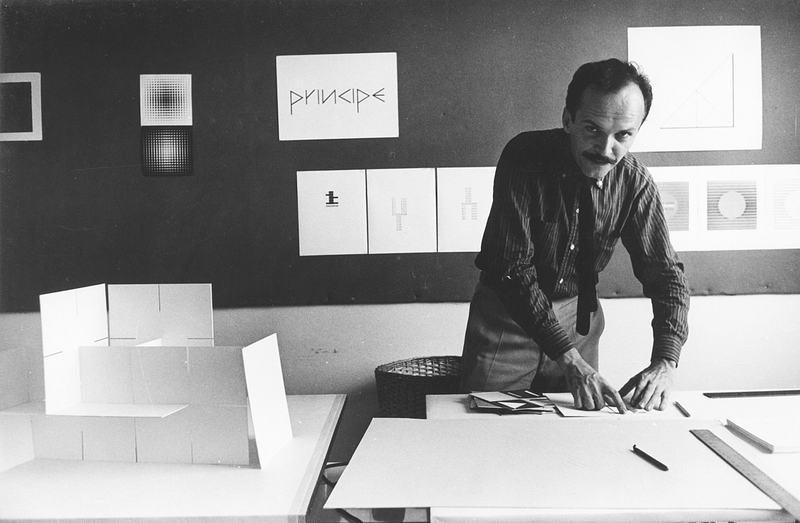
In 1956, a pivotal moment arrived in Philadelphia: Magalhães was embraced by the Philadelphia Print Club and began teaching at the Pennsylvania Academy of the Fine Arts. In collaboration with the typographer Eugene Feldman, he produced experimental titles such as Doorway to Portuguese and Doorway to Brasília, works that blended collage, photography, and innovative print techniques.
By 1963, back in Brazil, Magalhães helped found ESDI (Escola Superior de Desenho Industrial) in Rio de Janeiro — the first higher education institution in design in Brazil — where he taught and promoted an integrated, humanistic approach to graphic and industrial design.
Icons of Identity: Logos, Symbols, and Currency
Magalhães’s design language resonates through some of the most iconic visual markers of Brazilian identity:
— Logotype for Rio de Janeiro’s IV Centenary (1964)
— Rede Globo’s first symbol (1965)
— Symbol for the São Paulo Biennial Foundation
— Banknote redesigns for the Cruzeiro Novo (from 1966 onward)
Further extending his visual vocabulary, Magalhães developed identities for institutions such as Petrobras, Embratur, Banco do Estado de São Paulo, Oil & Light (Light), and various cultural organizations — culminating in an oeuvre of more than 180 visual identities.
Exhibitions, Leadership, and Cultural Advocacy
His visual work underwent prominent solo exhibitions across Brazil and abroad — from MAM São Paulo, Pan American Union in Washington, to the Fischbach Gallery in New York. Group shows included the 1959 MoMA acquisitions, the 1960 Venice Biennale, and the São Paulo Biennials of the 1950s and 1960s.
Beyond design, Magalhães exercised cultural leadership — coordinating national heritage projects, serving on Brazil’s cultural councils, leading IPHAN (Institute of Historic and Artistic Heritage) in 1979, and championing preservation through the Pró-Memória Foundation in the early 1980s.

Legacy: Institution, Memory, and National Recognition
Magalhães passed away in Padua, Italy, on June 13, 1982, while attending a meeting of Latin American Ministers of Culture. In his honor, Recife’s Metropolitan Gallery of Art was renamed the Aloísio Magalhães Museum of Modern Art (MAMAM) — a lasting testament to his influence.
Additionally, November 5 — his birthdate — was decreed as National Design Day in Brazil, a tribute to his pioneering contributions.
Why It Matters
As a curator, I invite you to consider Magalhães not merely as a designer but as a cultural cartographer: he synthesized place, identity, public memory, and modernist form into the visual architecture of a nation. Through logos, currencies, exhibitions, and museums, his work resonates across civic life and design history alike.
References
Wikipedia (PT): https://pt.wikipedia.org/wiki/Alo%C3%ADsio_Magalh%C3%A3es
Wikipedia (EN): https://en.wikipedia.org/wiki/Alo%C3%ADsio_Magalh%C3%A3es
Design Reviewed: https://designreviewed.com/the-logos-and-symbols-of-brazilian-designer-aloisio-magalhaes/
Google Arts & Culture (MAMAM): https://artsandculture.google.com/partner/mamam
UERJ Academic Article: https://www.e-publicacoes.uerj.br/arcosdesign/article/download/31413/43502/0