
Ecótono: Four Northeastern Poetics in a Zone of Contact
Ecótono begins with a question about survival: where are we going, and which worlds do we want to carry through the crossing? Curated by Lucas Dilacerda at Arte Plural Galeria in Recife, the exhibition brings together Daniélly Guerra, Gerson Ipirajá, Géssica Amorim, and Yasmin Formiga. Its title comes from ecology, where an ecotone is a transition zone between two or more ecosystems. Different species and environmental conditions meet there without losing their particularities, creating forms of coexistence produced by contact. Dilacerda translates that idea into a curatorial method. Rather than gathering the four artists under a single identity, the exhibition preserves the differences among their practices while tracing points of proximity across memory, ancestry, territory, body, and landscape. See also Gabriel Archanjo and the Figure as a Field of Resistance.
Daniélly Guerra approaches this zone through interior landscapes. Moving between painting, drawing, writing, photography, installation, and scenography, she draws on childhood, motherhood, everyday life, and dreams to explore processes of transformation. Organic forms such as stones, seeds, rivers, paths, and buds become signs of time and germination. In Amanda Refaz o Céu, broad dark fields and blue linear passages create an image poised between figure and abstraction, as though memory were being rebuilt from fragments. Gerson Ipirajá, by contrast, turns Afro-Indigenous ancestry into a vocabulary of survival and sacred form. His arrows, blades, circles, axes, masks, and tabernacles operate as an imagined ancestral alphabet. Ferramentas Ancestrais III condenses that language into a copper-colored emblem on black, simultaneously tool, weapon, entity, and guardian. See also Opening: Land of wind, water and salt Brings Leonilson and Zé Tarcísio into Fortaleza’s Present.

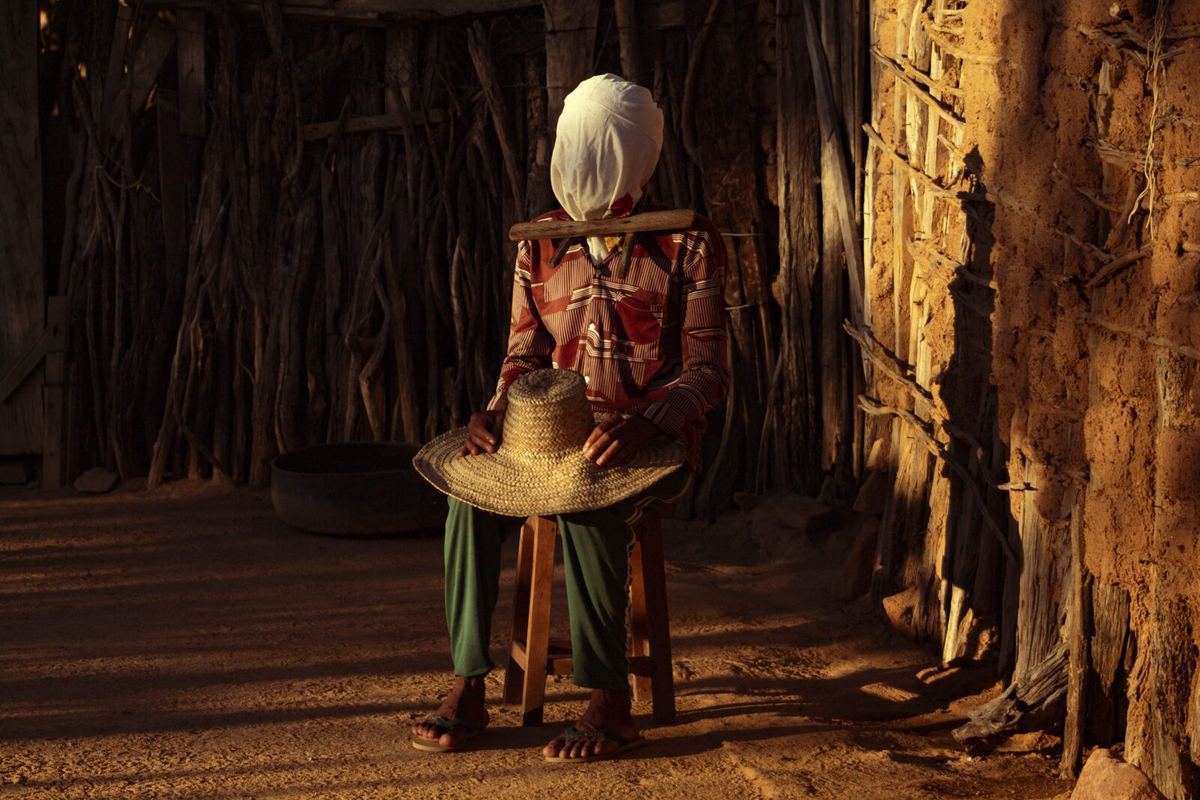
Géssica Amorim works from the Sertão do Pajeú, transforming territory into an affective and dreamlike field. Born in Custódia and based in Sítio dos Nunes, she uses photography to displace bodies, clothing, furniture, flowers, and ordinary objects into staged encounters between documentation and fiction. In the selected photograph, a seated figure occupies an earthen domestic space, the face covered and the body crossed by a wooden form. Warm light, adobe walls, woven straw, and fabric make the Sertão appear not as a static regional image but as a living architecture of memory and invention. Yasmin Formiga extends the exhibition toward the Caatinga as a living and ancestral entity. Through performance, installation, photography, painting, drawing, objects, and land art, she works directly with earth, stones, roots, seeds, and plants. Colheita sobre concreto - Milho places cultivated life against a rough mineral support, joining fragility, subsistence, and resistance in a compact object.

The exhibition’s strength lies in the way these distinct languages contaminate one another without becoming interchangeable. Daniélly’s subjective terrain, Gerson’s ancestral signs, Géssica’s Sertão, and Yasmin’s Caatinga meet as four propositions for inhabiting a damaged world. Against the destruction of territories, the erasure of memory, and the conversion of life into resource, Ecótono proposes relation, care, ancestry, and imagination as active forms of resistance. Every transition, the exhibition suggests, contains a dispute over what will remain possible. On view at Arte Plural Galeria through January 29, 2027, the exhibition turns the gallery into precisely such a threshold: a place where difference produces contact, and contact becomes a way of imagining survival.


