Geovane Cardoso: Creatures of the Sertão
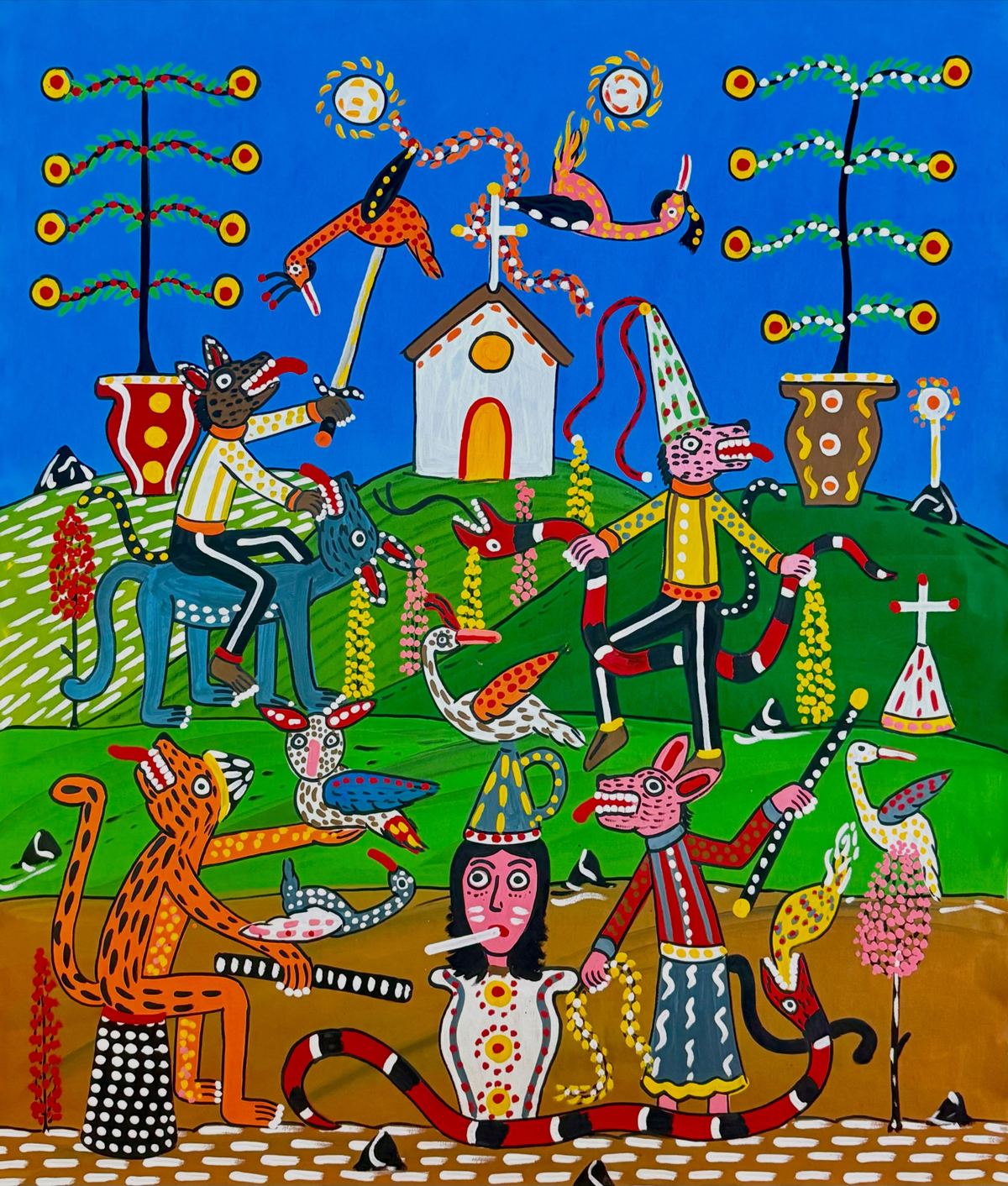
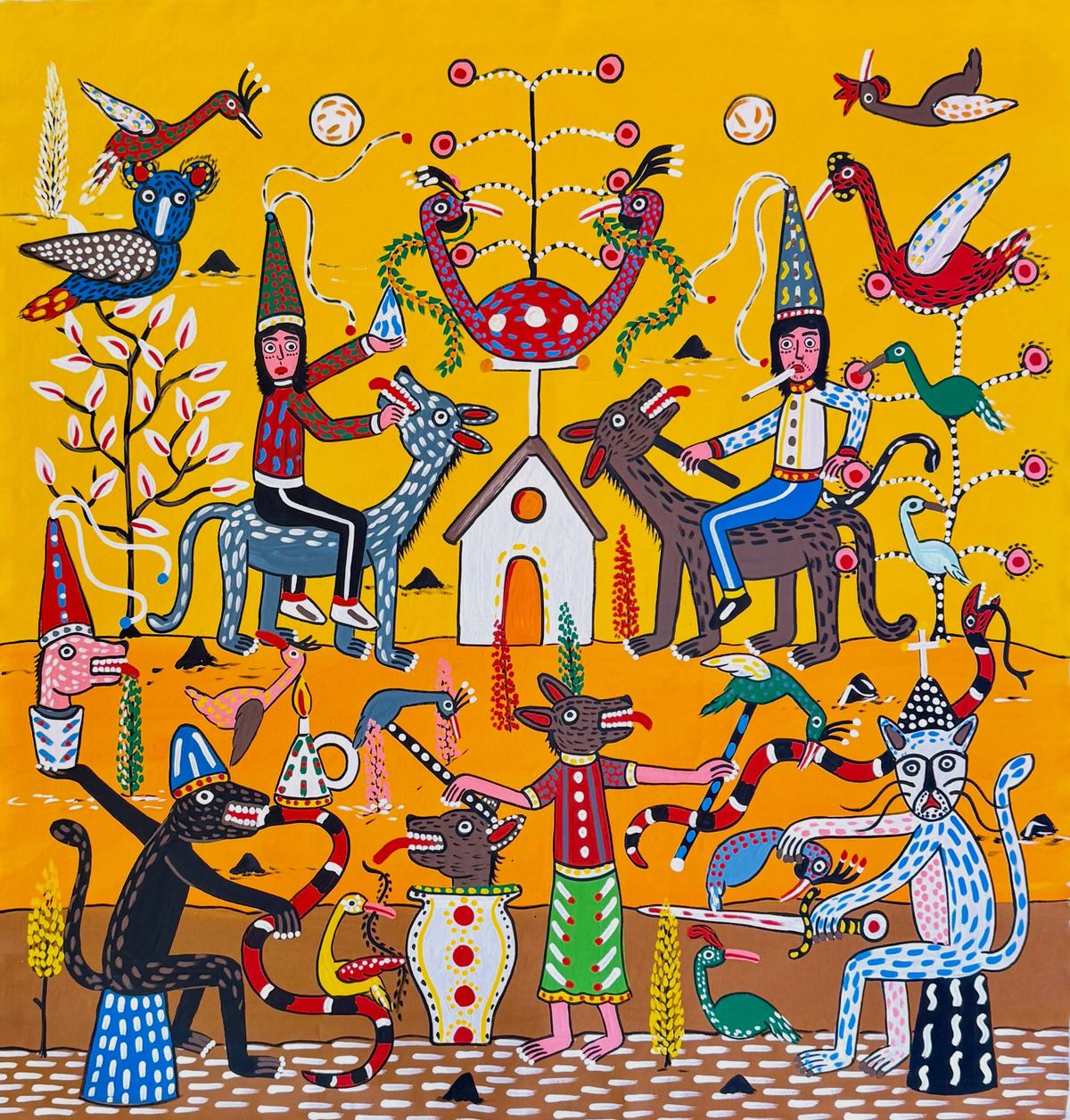
Geovane Cardoso paints a sertão populated by creatures that seem to have stepped out of a story still being invented. In the four paintings supplied for this article, birds, dogs, snakes, fantastical beasts, and human figures gather around small houses, flowering plants, and patterned vessels. Their bodies are outlined in dark strokes and filled with dots, stripes, and bright blocks of color. The scenes do not settle into naturalistic landscapes. Instead, they build a lively visual world from recognizable forms rearranged according to the picture’s own logic. The artist profile at Artsoul identifies Cardoso as born in Brejo Santo, Ceará, in 1995, and describes a practice shaped by family traditions of sculpture in wood and painting. It names his father as Francisco Graciano Cardoso and his grandfather as Manoel Graciano Cardoso, placing his work within an intergenerational artistic setting. See also Gabriel Archanjo and the Figure as a Field of Resistance.
The yellow paintings make this invented world especially vivid. In one, two long-legged figures in patterned clothing stand above a dense green animal, while smaller birds and creatures fill the open ground around them. The composition is almost theatrical: figures face one another, hold staffs, or ride animals, but no single episode explains the gathering. A second yellow scene spreads its cast across a broader field. A small white house anchors the middle, while people, animals, and birds cluster around it in pairs and groups. Their repeated eyes and open mouths give them a shared graphic character, even as their colors and patterns distinguish each body. The flat, saturated background keeps the scene legible as an image while allowing its many details to accumulate without conventional depth. See also Pedro Lucena and the Ground of Origin.

In the red painting, the same cast becomes more tightly packed. Animals and human figures overlap around another small house, and a large green creature cuts across the center like a bridge between separate episodes. The red ground changes the mood without changing the work’s visual language: white marks, yellow plants, and blue and pink bodies press forward against it. A blue-ground painting offers a different sense of space. Green hills and a brown path create horizontal bands beneath a small house, while long-limbed figures and animals move through the foreground. The shift from warm, enclosed fields to open blue sky makes the scene feel more expansive, though the patterned bodies remain unmistakably part of the same imaginative universe.

Across these works, repetition is a tool for making difference visible. Dots and stripes bind the creatures together, but each figure bends, stretches, or turns in its own way. Houses, plants, and vessels provide familiar points of orientation amid the abundance, while the animals often behave like characters rather than background details. Artsoul notes that Cardoso’s practice draws on the cultural heritage of his family and describes his images as connected to the forms and colors of the Northeastern sertão. The paintings themselves support a more specific observation: they transform that landscape into a populated, playful world where humans and animals share the same visual stage. Cardoso leaves the relationships open. Viewers can follow an encounter, invent a story, or simply move from one patterned creature to the next.