Leonilson: The Quiet Confessions Stitched into Fabric
José Leonilson Bezerra Dias, known simply as Leonilson, was an artist who turned his life into a tapestry of symbols, words, and intimate confessions.
In the vibrant, often boisterous landscape of Brazilian contemporary art, there emerged a voice of exquisite tenderness and raw honesty, one that chose the needle and thread over the brush to articulate its deepest truths. José Leonilson Bezerra Dias, known simply as Leonilson, was an artist who turned his life into a tapestry of symbols, words, and intimate confessions. From his roots in the sun-drenched Northeast to the bustling art scene of São Paulo, Leonilson’s journey was one of profound self-exploration, culminating in a body of work that speaks volumes about love, loss, identity, and the fragile beauty of the human spirit.
Leonilson’s art offers a rare glimpse into an artist's soul, a delicate yet powerful testament to the act of living and feeling. His pieces, often small-scale and intricate, invite viewers into a dialogue that is at once intensely personal and universally resonant. Through a unique visual language of stitched narratives, he transcended the boundaries of traditional media, carving out a space for vulnerability and introspection that continues to captivate and inspire.
From Ceará to the Global Stage: Leonilson's Early Journey
Born in Fortaleza, Ceará, in 1957, Leonilson's early life in Brazil's Northeast laid the foundation for an artistic sensibility deeply attuned to storytelling and the rich textures of existence. While his family moved to São Paulo in the 1960s, a common trajectory for many Brazilians seeking opportunities in the burgeoning metropolis, his origins undoubtedly contributed to a certain poetic and narrative impulse that would later define his work.
His formal artistic education began at the Fundação Armando Álvares Penteado (FAAP) in São Paulo in the late 1970s, a period of significant artistic ferment in Brazil. It was here that Leonilson began to hone his skills, initially working with painting and drawing, exploring the expressive possibilities of these traditional mediums. The early 1980s proved to be a pivotal time for the young artist as he embarked on travels to Europe and New York. This exposure to international art scenes, particularly the burgeoning transavantgarde and neo-expressionist movements, profoundly influenced his developing style. He absorbed the raw energy and subjective narratives prevalent in these trends, integrating them into his distinctly Brazilian perspective.
Upon his return, Leonilson quickly became a central figure in what became known as "Geração 80" (Generation 80). This group of artists, largely based in Rio de Janeiro and São Paulo, reacted against the conceptual austerity of the preceding decades, embracing a return to painting, figuration, and personal expression. Leonilson, however, stood out even within this diverse group. While many of his peers explored large-scale, often politically charged canvases, Leonilson began to turn inward, developing a more intimate, almost diaristic approach to his art.
The Evolution of an Intimate Language: From Canvas to Cloth

Accepted by heuristic filter before Gemini vision. Educational use.
Leonilson's early works, such as "A Defesa e o Lar" (The Defense and the Home) from 1984, show a robust engagement with painting, often featuring bold colors and symbolic imagery. Yet, even in these pieces, there was an emerging sense of personal mythology, a nascent vocabulary of symbols that would later become his signature. He participated in major international exhibitions, including the São Paulo Biennial in 1985 and 1989, and the Venice Biennial in 1986, solidifying his reputation on the global stage (Wikipedia).
However, it was in the late 1980s and early 1990s that Leonilson's practice underwent its most radical and defining transformation. He gradually moved away from traditional painting, embracing textiles, embroidery, and found objects as his primary mediums. This shift was not merely aesthetic; it was deeply personal, driven by a desire for a more tactile, vulnerable, and direct form of expression. His canvases shrank, giving way to delicate fabrics—linen, cotton, and silk—upon which he meticulously stitched his thoughts, dreams, fears, and observations.
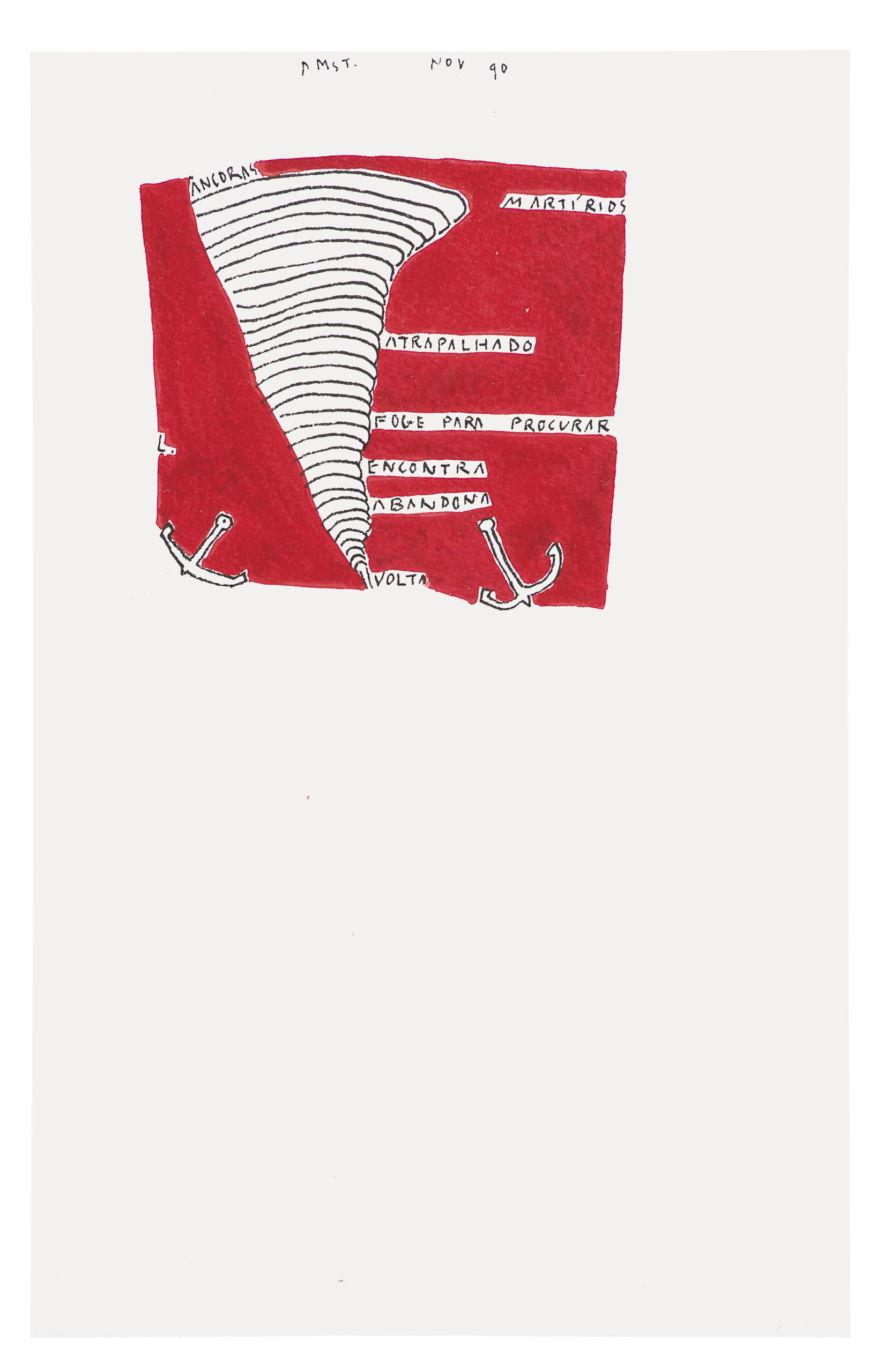
His later works are characterized by a fragile poetry, often incorporating handwritten text, simple drawings, and a recurring lexicon of symbols: hearts, stars, houses, numbers, maps, and figures. These elements were not merely decorative; they formed a visual diary, a fragmented narrative of his inner world. He would often sew buttons, beads, and pieces of thread onto the fabric, transforming these humble materials into precious relics imbued with profound meaning. The act of embroidery itself—slow, repetitive, meditative—became integral to the artwork's message, mirroring the introspective process of self-reflection.
A Profound Shift: Art as a Testament to Life and Mortality
The most significant turning point in Leonilson's life and art came with his HIV diagnosis in 1991. This moment profoundly altered his perspective, injecting a new urgency and depth into his work. His art became a direct engagement with his illness, his body, mortality, and spirituality. Themes of vulnerability, solitude, and the ephemeral nature of existence became central. Yet, even in the face of profound personal struggle, his work never descended into despair. Instead, it radiated a quiet resilience, a search for meaning and beauty amidst suffering.
His post-diagnosis works are often referred to as "diaries" or "notebooks," stitched meditations on his condition, his relationships, and his reflections on life's ultimate questions. These pieces, despite their intimate scale, possess an immense emotional weight. They speak of love desired and lost, of the body's betrayals, and of the enduring spirit that seeks connection and understanding. Leonilson's willingness to expose his deepest fears and hopes, to render his personal battle into a universal human experience, made his art incredibly powerful and resonant. He transformed his suffering into a form of spiritual inquiry, using his art as a means of processing, communicating, and perhaps, finding solace.

Accepted by heuristic filter before Gemini vision. Educational use.
Leonilson's Enduring Cultural Impact
Leonilson's premature death in 1993, at the age of 36, left a void in Brazilian art, but his legacy continued to grow. His contribution to contemporary Brazilian art is immense, particularly for his pioneering use of unconventional materials and his groundbreaking exploration of personal narratives, identity, and queer themes in a deeply vulnerable and non-confrontational manner. At a time when many artists were still navigating the complexities of political and social commentary, Leonilson bravely turned inward, demonstrating that the personal is indeed political, and that intimate stories can possess universal resonance.
His work provided a powerful, empathetic voice during the AIDS crisis, offering a poignant human dimension to a global tragedy. By stitching his experiences, he not only documented his own journey but also gave form to the unspoken anxieties and hopes of many. His art serves as a testament to the transformative power of vulnerability, showing how an artist can channel personal struggle into profound beauty and meaning.
Leonilson's influence extends beyond his thematic concerns. His innovative approach to materials and techniques—the elevation of embroidery and textiles from craft to high art—paved the way for subsequent generations of artists in Brazil and beyond to experiment with diverse media and challenge traditional hierarchies. He proved that delicacy does not equate to weakness, but rather, can be a source of immense strength and emotional depth.
A Legacy Stitched in Time
Leonilson's art remains a beacon of honesty and emotional intelligence. His quiet confessions, stitched into fabric with such meticulous care, continue to resonate with audiences worldwide. He reminds us that true strength often lies in vulnerability, and that the most profound stories are sometimes told not with grand gestures, but with the delicate whisper of a needle and thread. From the vibrant culture of Ceará to the global art stage, Leonilson’s journey was a testament to the power of art to transform personal experience into universal poetry, leaving behind a legacy as intricate and enduring as his beloved embroidered pieces.
Fontes:
(1) dailyartfair.com - https://dailyartfair.com/artist/leonilson
(2) Wikipedia - https://pt.wikipedia.org/wiki/Leonilson
Imagem de capa: Accepted by heuristic filter before Gemini vision. Educational use.
This article is part of the CASCA Archive, documenting visual artists from Northeast Brazil. Story about Leonilson.