Mestre Didi: Where Spirit Takes Form
Among these luminaries, Deoscóredes Maximiliano dos Santos, universally known as Mestre Didi, shines with an ethereal glow.
In the vibrant tapestry of Brazilian art, certain figures stand out not just for their aesthetic brilliance but for their profound connection to the cultural and spiritual currents that define their land. Among these luminaries, Deoscóredes Maximiliano dos Santos, universally known as Mestre Didi, shines with an ethereal glow. More than an artist, Didi was a living bridge between the seen and unseen worlds, an Alapini (sumo priest) whose sculptures were not merely objects but sacred conduits, embodying the very soul of Afro-Brazilian heritage. His singular oeuvre, deeply rooted in the Candomblé universe, offers a powerful testament to the enduring legacy of African spirituality in the Americas, transforming ancestral memory into tangible, compelling forms.
Born in Bahia in 1917, Mestre Didi's life was inextricably linked to the rich, complex spiritual landscape of Northeast Brazil. Bahia, a state often called the "Black Rome" of Brazil, is the heartland of Afro-Brazilian culture, where the echoes of ancient African traditions resonate powerfully in daily life, music, dance, and religion. It was in this crucible of cultural synthesis that Didi was forged, not just as a man but as a spiritual leader and artistic visionary.
His journey began within the hallowed traditions of Candomblé, an Afro-Brazilian religion that emerged from the fusion of various West African spiritual practices, particularly those of the Yoruba people, brought to Brazil by enslaved Africans. Within this profound spiritual framework, Didi ascended to the revered position of Alapini, the supreme priest of the Egungun cult. The Egungun are the collective spirits of the ancestors, revered and invoked for their wisdom, protection, and guidance. This role was not merely a title; it was the very essence of his being, a sacred responsibility that informed every aspect of his life, including his artistic expression. As an Alapini, Mestre Didi was tasked with mediating between the living and the ancestral spirits, ensuring the continuity of traditions and the well-being of his community. This deep spiritual calling was the wellspring from which his artistic practice flowed.
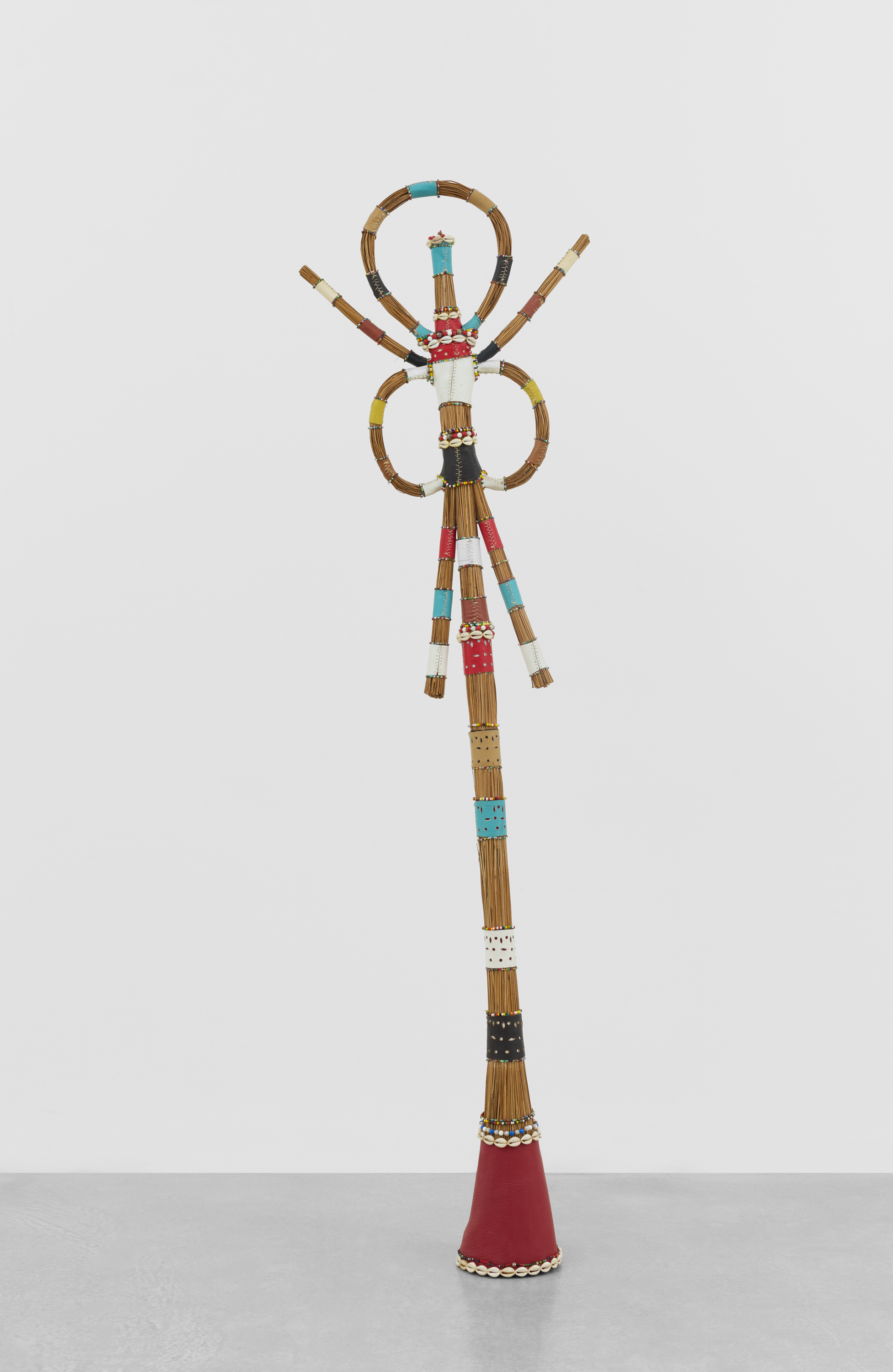
Mestre Didi's visual practice centered on escultura—sculpture—but to call his creations merely "sculptures" feels insufficient. They are, perhaps more accurately, spiritual forms, sacred assemblages, and totemic structures that evoke the presence of the orixás (deities) and the Egungun ancestors. Unlike many Western art forms that prioritize individual expression or aesthetic beauty above all else, Didi’s work was fundamentally communal and spiritually functional. Each piece was imbued with meaning, crafted with intention, and deeply connected to the cosmology of Candomblé.

James Cohan, selected works page for Mestre Didi.
While specific materials are not detailed in the sources, the nature of Candomblé art often involves natural elements: shells, beads, fibers, raffia, palm fronds, cowries, and found objects, all carefully selected for their symbolic power and spiritual resonance. Didi’s sculptures are known for their intricate textures, rhythmic patterns, and often abstract or symbolic representations that hint at unseen forces and ancient narratives. They are not literal depictions but rather evocations, designed to stir spiritual recognition and connection. Through these forms, Didi gave tangible shape to the intangible, making the sacred visible and accessible. His work allowed viewers to glimpse the complex spiritual universe of Candomblé, inviting them to engage with its profound truths and ancestral wisdom.
Beyond his sculptural practice, Mestre Didi was a polymath whose influence extended across multiple cultural domains. He was a prolific writer, penning works that explored Afro-Brazilian history, culture, and spirituality, thereby preserving and disseminating knowledge that was often marginalized or misunderstood. As an educator, he shared his profound understanding of Candomblé, demystifying its practices and promoting its cultural significance. He was also a curator, shaping exhibitions that brought Afro-Brazilian art and spirituality to wider audiences, and a dramatist, using performance to tell stories of his heritage. Furthermore, his role as an activist underscored his commitment to fighting for the recognition and respect of Afro-Brazilian rights and cultural identity. His life was a testament to the power of art and spirituality as tools for cultural affirmation and social change.
Mestre Didi's impact on Brazilian art and culture is immeasurable. He was instrumental in elevating Afro-Brazilian aesthetic traditions from the realm of ethnography to the status of high art, showcasing their complexity, beauty, and profound spiritual depth on national and international stages. His work challenged preconceived notions about what constitutes "art," asserting the validity and power of forms born from spiritual practice and ancestral memory. Through his art and his life, Didi helped to foster a deeper appreciation for the contributions of African descendants to the cultural fabric of Brazil, advocating for a more inclusive and equitable understanding of Brazilian identity.

James Cohan, selected works page for Mestre Didi.
His exhibitions, such as "Mestre Didi: Spiritual Form," brought his unique vision to a global audience, allowing people from diverse backgrounds to experience the potency and beauty of Candomblé-inspired art. These presentations were not just art shows; they were cultural exchanges, dialogues that bridged continents and histories, revealing the enduring vitality of African traditions in the diaspora. Mestre Didi, who passed away in 2013, left behind a monumental legacy—a body of work that continues to inspire, educate, and connect us to the profound spiritual heritage of Bahia.
In a world increasingly seeking meaning beyond the material, Mestre Didi's art offers a powerful reminder of the enduring human need for spiritual connection and ancestral wisdom. His sculptures are not static objects but living testaments to the power of faith, memory, and artistic vision. They whisper ancient truths, hum with the energy of the orixás, and stand as proud monuments to a culture that has continuously found ways to express its spirit, even in the face of adversity. Mestre Didi truly made the spirit take form, leaving an indelible mark on the landscape of global art and spirituality.
Fontes:
(1) elmuseo.org - https://elmuseo.org/exhibition/mestre-didi-spiritual-form-br/
(2) jamescohan.com - https://www.jamescohan.com/exhibitions/mestre-didi
(3) instagram.com - https://www.instagram.com/p/DLYQ1D_voZL/
Imagem de capa: James Cohan, selected works page for Mestre Didi.
This article is part of the CASCA Archive, documenting visual artists from Northeast Brazil. Story about Mestre Didi.