Naiana Magalhães: The Rumor of a Nuclear Bomb
An alleged nuclear test in the Ceará sertão is an unexpected starting point for a family photobook. In Coração de Touro, Naiana Magalhães follows that troubling account through an archive of photographs, oral memories and historical reporting. Published by {Lp} press, the book brings private recollections into contact with stories of foreign military power and unexplained events in Northeast Brazil. The artist’s inquiry includes the United States military presence during the Second World War and UFO narratives associated with Quixadá. These threads are placed in conversation without being treated as proof of one another. The nuclear test remains an unverified allegation; its presence in the book asks how an account circulates, who preserves it, and what happens when it is read beside the ordinary lives recorded in a family album. See also Ecótono: Four Northeastern Poetics in a Zone of Contact.
The family archive gives that investigation an intimate scale. The launch account describes an archive of relatives, landscapes and farm animals, including photographs made by Magalhães’s grandmother, who documented newborn calves and cattle. In one reproduction, four women pose beside a broad stretch of water. Two stand while two sit or crouch near the shore; their arrangement gives the image a gentle, improvised symmetry. Behind them, the low horizon makes the sky feel expansive. Scratches, stains and uneven tones register the photograph’s passage through time. Another image shows a woman on horseback beneath a clouded sky. Its reddish cast spreads across the rider and animal, drawing attention to color as a condition of the surviving print. Neither image supplies a complete account of the occasion it records. Together, they make family memory tangible through bodies, gestures and the altered surfaces of photographs. See also Opening: Land of wind, water and salt Brings Leonilson and Zé Tarcísio into Fortaleza’s Present.

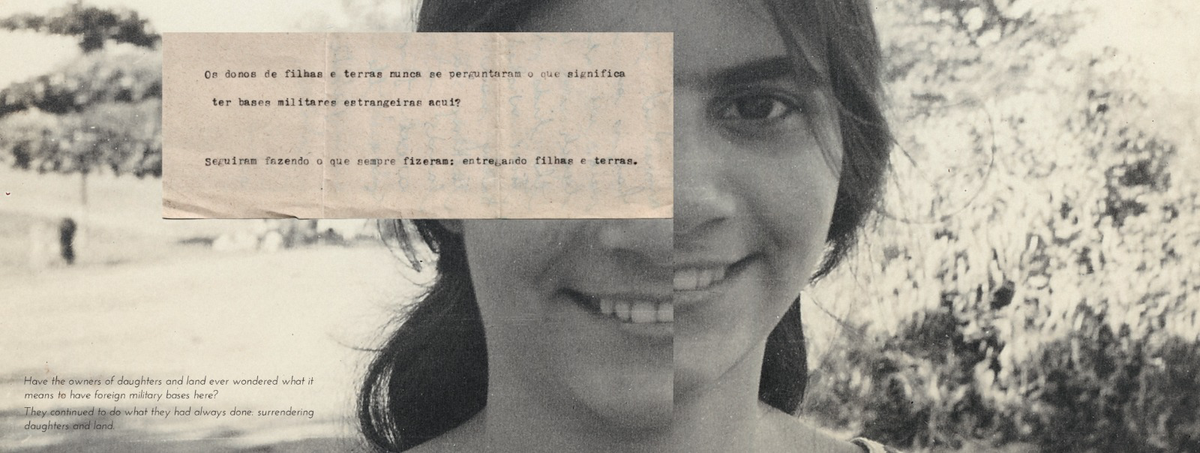
A third reproduction places a typewritten passage across an enlarged face. The paper interrupts the photograph and introduces a question about foreign military bases, land and daughters. That juxtaposition shifts the act of reading: a familiar-looking face becomes the ground against which a political proposition must be considered. The book’s use of period newspapers adds another register, bringing public language into contact with private remembrance. Headlines, oral accounts and family photographs carry different kinds of authority, and their proximity invites scrutiny rather than an automatic conclusion. Seen this way, the archive becomes an arrangement of voices and gaps. Its women appear both within the images and, through the grandmother’s photographic activity, within the work of making a record. Their presence gives the investigation a point of view grounded in relationships rather than in the promise of a final revelation.

Born in Fortaleza in 1986, Magalhães graduated in Visual Arts from the University of Fortaleza and completed a master’s degree in Arts at the Federal University of Ceará in 2018. Her practice spans photography, video, objects and installation. She participated in the tenth Mercosul Biennial and the Paço das Artes project program, and was nominated for the PIPA Prize in 2016. Coração de Touro extends that practice into the space of the edited book, with image editing by Carolina Cattan and Rony Maltz. The photobook was selected for the 2026 ZUM/IMS Photobook Open Call. Its encounter between domestic images and disputed histories asks the reader to remain attentive to the people who preserved these photographs, and to the histories that a family album can bring into view without fully resolving.