The Adopted Son's Legacy: J. Miguel and the Living Tradition of Northeast Brazilian Woodcut Art
In the dusty streets of Bezerros, Pernambuco, where the scent of wood shavings mingles with the arid air of Brazil's Northeast, a quiet artistic revolution has been taking place for decades.
In the dusty streets of Bezerros, Pernambuco, where the scent of wood shavings mingles with the arid air of Brazil's Northeast, a quiet artistic revolution has been taking place for decades. At its heart stands J. Miguel—born José Miguel da Silva in 1961—a man whose journey from adopted son to celebrated master xilogravurista embodies the living, breathing tradition of Brazilian popular art.
J. Miguel's story begins not with blood, but with choice. As the adopted son of the legendary J. Borges, one of Brazil's most revered woodcut artists, Miguel inherited something far more valuable than genes: he inherited a centuries-old artistic tradition that flows through the hands like muscle memory, connecting contemporary Brazil to its colonial past and indigenous roots.
The art of xilogravura—Brazilian woodcut printing—arrived in the Northeast through Portuguese colonizers, but it was the region's storytellers, poets, and folk artists who transformed it into something uniquely Brazilian. In this tradition, J. Miguel found his calling under the patient tutelage of his stepfather, learning to carve stories into wood with the precision of a surgeon and the soul of a poet.
Working alongside his stepbrother Manasses, Miguel developed his craft in the family workshop, where the rhythmic sound of carving tools against wood has echoed for generations. His early works were modest in size but ambitious in scope, capturing the attention of art dealers and collectors who recognized something special in his precise lines and evocative imagery.
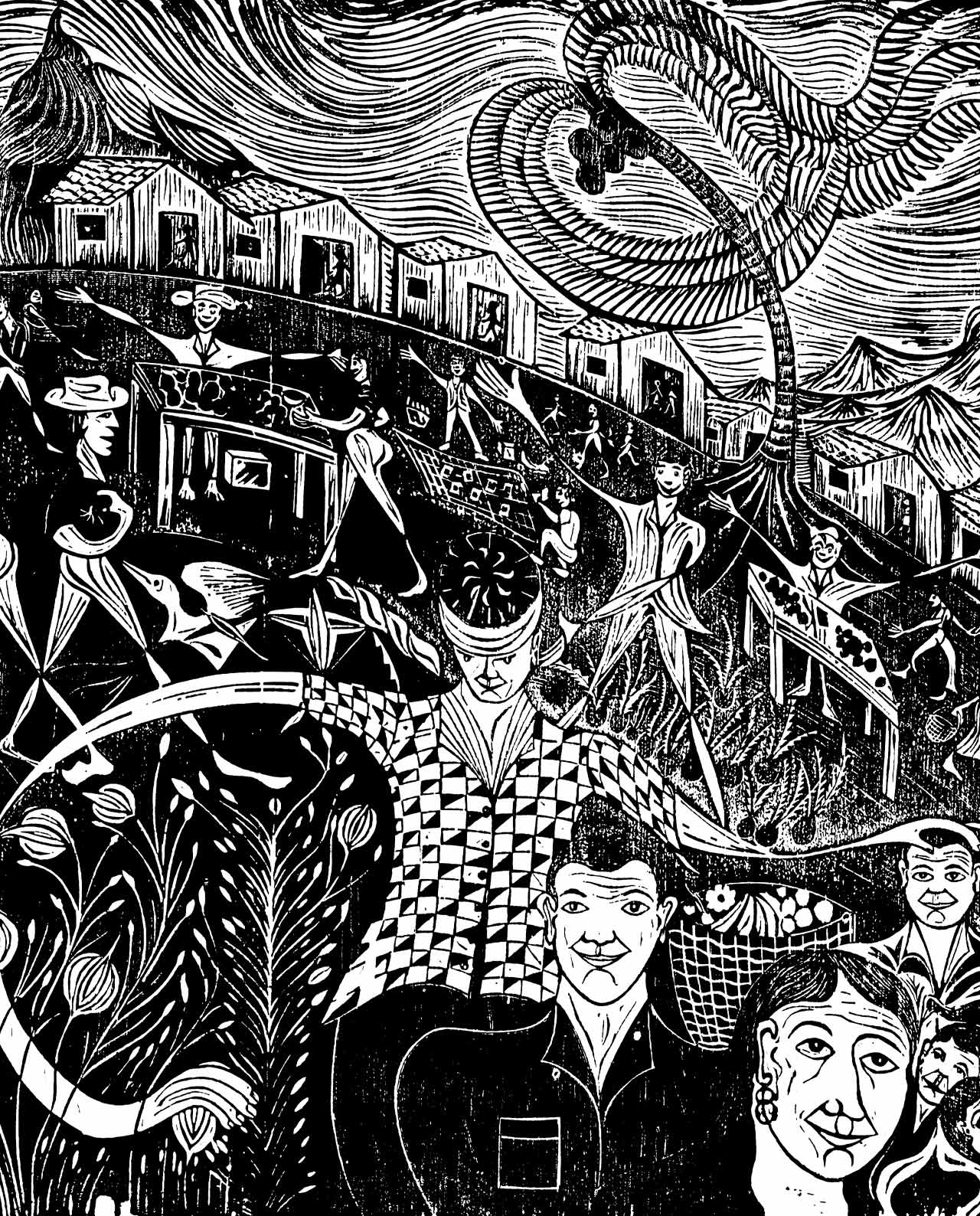
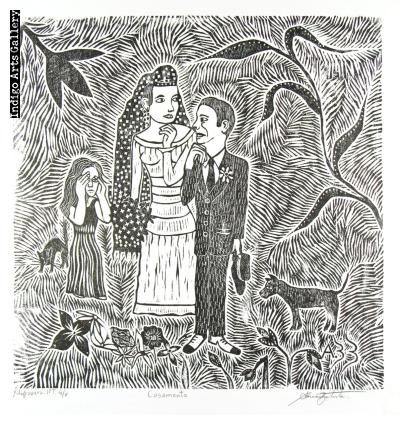
What sets J. Miguel apart is his ability to bridge the sacred and the secular, the traditional and the contemporary. His prints encompass a remarkable range of subjects: from tender depictions of Catholic saints that speak to the deep religiosity of Northeast Brazil, to stark, unflinching portrayals of the region's devastating droughts that have shaped its people's resilience for centuries.
Each of Miguel's woodcuts serves as a visual chronicle of Northeast Brazilian life. His religious imagery reflects the syncretic spirituality of the region, where Catholic saints often bear the features and stories of African orixás, creating a unique spiritual landscape that his art both documents and celebrates. These pieces aren't mere decorations—they're devotional objects that connect viewers to a living faith tradition.

Verified via Claude Vision. Educational use.
Equally powerful are his depictions of the seca—the periodic droughts that have defined Northeast Brazilian experience for generations. Through his carved lines, Miguel captures not just the physical reality of parched earth and struggling families, but the psychological landscape of a people who have learned to find hope in the harshest conditions. These works serve as both historical document and social commentary, preserving the memory of hardship while celebrating human endurance.
The celebrations and festivals of the Northeast also find expression in Miguel's work. His prints capture the explosive joy of Carnaval, the solemnity of religious processions, and the everyday moments of community life that define regional identity. Through his eyes, we see a culture that refuses to be diminished by economic hardship or geographic isolation.
J. Miguel's career trajectory illustrates the evolving status of popular art in contemporary Brazil. Beginning with sales at regional fairs—the traditional marketplace for xilogravura—his work gradually found its way into galleries in major Brazilian cities like Recife and Rio de Janeiro. This transition from folk art to fine art reflects broader changes in how Brazilian culture values its popular traditions.
Despite commercial success, Miguel has remained true to his roots. He continues to work from Bezerros, maintaining the connection between his art and the landscape that inspires it. His collection now includes over 100 works, some of which have been exhibited in prestigious venues, yet he hasn't forgotten the humble fair stalls where xilogravura has traditionally found its audience.
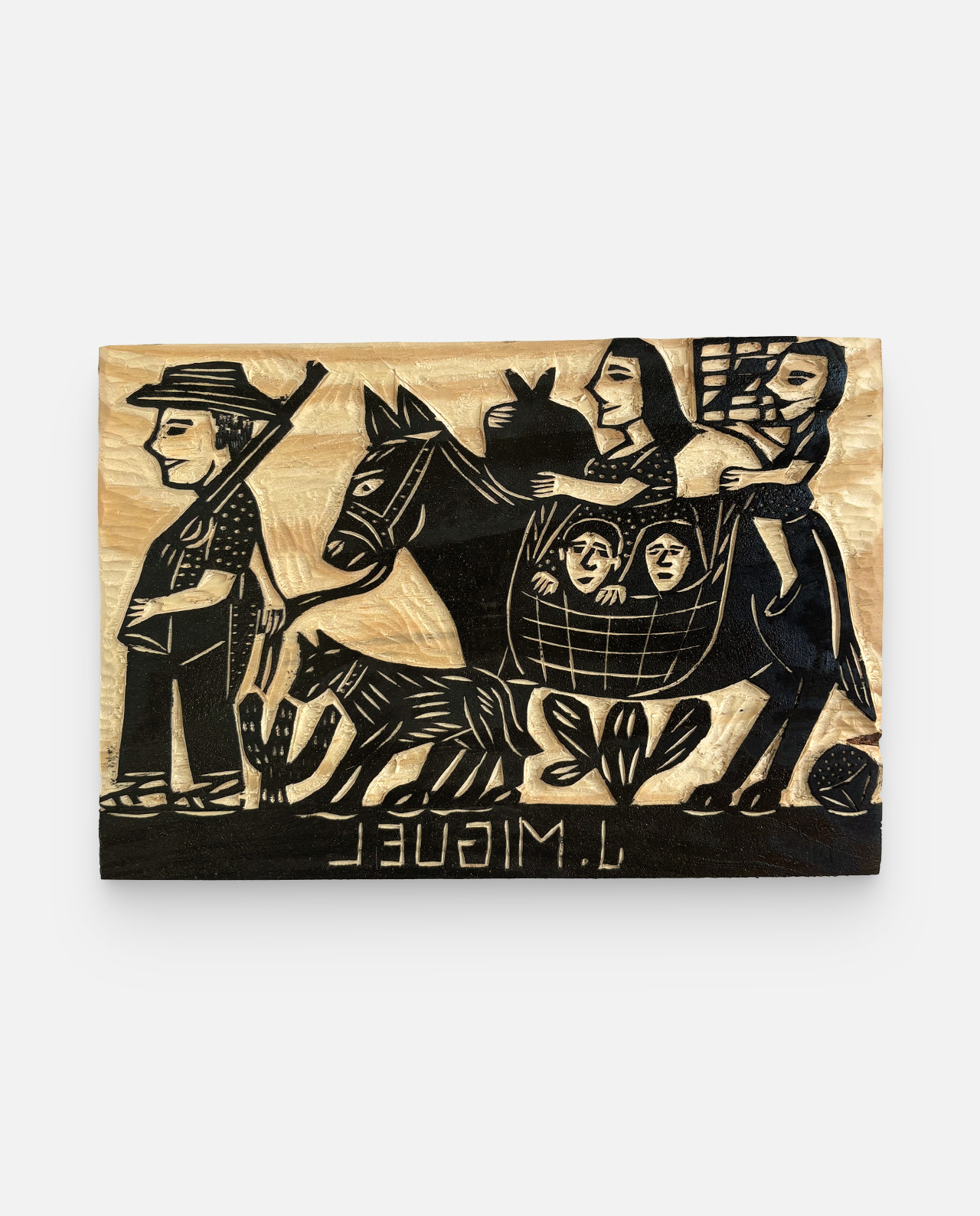
The artist's relationship with his matrices—the carved wooden blocks from which prints are made—reveals both the commercial realities and artistic integrity of his practice. While he has sold many of these original blocks to collectors, he has carefully preserved others, understanding their value as both artistic objects and cultural artifacts.

Verified via Claude Vision. Educational use.
Today, J. Miguel represents more than just individual artistic achievement; he embodies the continuity of Northeast Brazilian cultural expression. In a rapidly globalizing world where traditional crafts often struggle to survive, his success demonstrates that authentic regional art can find contemporary relevance without losing its essential character.
His work serves as a bridge between generations, connecting young Brazilians to their cultural heritage while introducing international audiences to the rich artistic traditions of the Northeast. Through exhibitions in major cities and the growing interest of collectors, Miguel's xilogravuras carry the stories, struggles, and celebrations of his region far beyond its geographic boundaries.
The legacy of J. Miguel extends beyond his individual works to encompass his role in preserving and transmitting the xilogravura tradition. Like his stepfather before him, he represents a living link in an artistic chain that stretches back centuries, ensuring that the carved stories of Northeast Brazil continue to speak to future generations.
In an age of digital reproduction and mass production, J. Miguel's hand-carved prints remind us of art's power to preserve cultural memory and human experience. Each line cut into wood carries the weight of tradition and the hope of continuity—a testament to the enduring power of popular art to capture the soul of a people and a place.
Fontes:
(1) convida.org - http://www.convida.org/j.miguel.html
(2) instagram.com - https://www.instagram.com/p/DBV4S5sxQoe/
(3) instagram.com - https://www.instagram.com/reel/DQb-irLDrhZ/
Keywords: xilogravura, Brazilian folk art, Northeast Brazil
Imagem de capa: Source: instagram.com. Credibility: 0.7.
This article is part of the CASCA Archive, documenting visual artists from Northeast Brazil. Story about J. Miguel.