The Mythmaker of Recife: Francisco Brennand's Ceramic Universe
In the sweltering heat of Recife, where the Atlantic Ocean meets the mangroves of Northeast Brazil, stands one of the most extraordinary artistic complexes in Latin America.
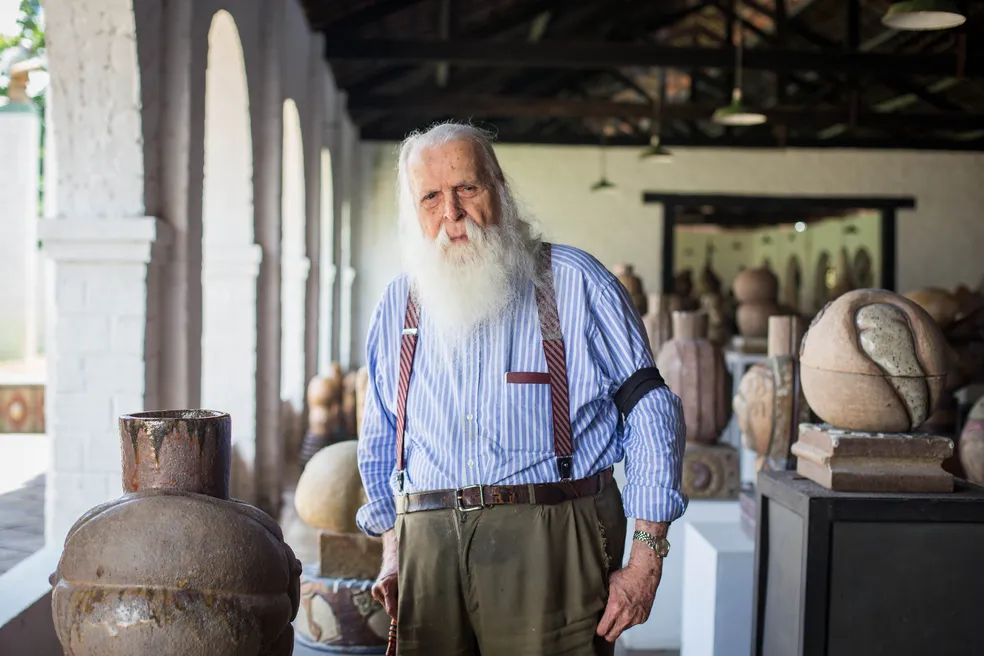
In the sweltering heat of Recife, where the Atlantic Ocean meets the mangroves of Northeast Brazil, stands one of the most extraordinary artistic complexes in Latin America. The Oficina Cerâmica Francisco Brennand sprawls across 15 acres like an ancient temple complex, filled with towering ceramic sculptures that seem to breathe with primordial life. This is the life's work of Francisco Brennand (1927-2019), a visionary artist who spent seven decades transforming humble clay into a mythological universe that bridges the ancient and contemporary worlds.
Born into one of Pernambuco's most influential families, Francisco Brennand could have easily lived a life of comfortable privilege. Instead, he chose the path of the artist, dedicating himself to an obsessive pursuit of ceramic mastery that would ultimately revolutionize Brazilian sculpture and establish him as one of the most important artists of his generation.

Image from Google Images search. Educational use.
Francisco de Paula Brennand was born in Recife in 1927, the son of Ricardo Brennand, a prominent businessman and art collector. The family's wealth, built on industries ranging from ceramics to sugar, provided young Francisco with early exposure to art and culture. However, it was not privilege but passion that would define his artistic journey.

Image from Google Images search. Educational use.
In the 1940s, Brennand traveled to Paris to study painting at the Académie de la Grande Chaumière. This European sojourn exposed him to the modernist movements sweeping through post-war Europe, but rather than simply adopting European aesthetics, Brennand began developing a unique visual language that would draw from both international modernism and the rich cultural traditions of Northeast Brazil.

Image from Google Images search. Educational use.
Upon returning to Recife in the early 1950s, Brennand made a pivotal decision that would shape the rest of his career. He abandoned painting and turned to ceramics, taking over the family's ceramic factory and transforming it into his artistic laboratory. This wasn't merely a career change—it was a homecoming to the earth itself, to the clay that had sustained his family's business and the ancient traditions of ceramic art that stretched back millennia.

Image from Google Images search. Educational use.
What emerged from Brennand's workshop over the following decades was nothing short of revolutionary. Working primarily in terracotta, he developed a distinctive style that merged pre-Columbian influences with contemporary sensibilities, creating sculptures that seemed to channel the spiritual energy of ancient civilizations while speaking directly to modern concerns.

Image from Google Images search. Educational use.
His signature works—monumental female figures, totemic animals, and hybrid creatures—populate his workshop like inhabitants of a parallel universe. These aren't merely decorative objects but powerful totems that explore themes of fertility, sexuality, death, and rebirth. The female form, in particular, became central to his iconography, rendered not as idealized beauty but as primal force, embodying the creative and destructive powers of nature.

Image from Google Images search. Educational use.
Brennand's technique was as distinctive as his imagery. He worked the clay with an almost violent intensity, using his hands, feet, and improvised tools to coax forms that seemed to emerge organically from the earth. The surfaces of his sculptures bear the traces of this physical engagement—rough textures, intentional imperfections, and a raw vitality that speaks to the artist's direct relationship with his material.

Image from Google Images search. Educational use.
The scale of his ambition was equally impressive. Some of his ceramic murals stretch for hundreds of feet, creating immersive environments that transform architectural spaces into sacred precincts. His installation at the Recife Metro system, for example, brings his mythological universe into the daily lives of thousands of commuters, democratizing access to art in a way that reflects his deep commitment to his local community.

Image from Google Images search. Educational use.
Brennand's work cannot be understood apart from the cultural landscape of Northeast Brazil, a region where indigenous, African, and European traditions have mingled for centuries to create a unique cultural synthesis. His sculptures draw deeply from this mestizo heritage, incorporating elements from Afro-Brazilian religions, indigenous cosmologies, and Catholic iconography into a personal mythology that speaks to universal human experiences.
This cultural fusion is perhaps most evident in his treatment of the sacred feminine. His female figures echo both the orixás of Candomblé and the fertility goddesses of pre-Columbian cultures, while also incorporating European artistic traditions. Yet these influences are never simply appropriated—they are transformed through Brennand's unique vision into something entirely new, a visual language that is unmistakably Brazilian while remaining universally accessible.
The artist's commitment to his regional identity extended beyond his artistic practice. By establishing his workshop in Recife and remaining there throughout his career, Brennand helped establish Northeast Brazil as a vital center of contemporary art, challenging the cultural hegemony of cities like São Paulo and Rio de Janeiro. His success demonstrated that artistic innovation could emerge from anywhere, not just established cultural capitals.
When Francisco Brennand died in 2019 at the age of 92, he left behind not just a body of work but an entire world. His workshop continues to operate as both museum and active artistic space, preserving his legacy while inspiring new generations of artists. The nearby Instituto Ricardo Brennand, founded by his cousin, creates a cultural complex that has transformed their corner of Recife into a pilgrimage site for art lovers from around the world.
Brennand's influence extends far beyond the boundaries of ceramic art. He demonstrated how an artist could remain deeply rooted in local traditions while creating work of international significance. His example has inspired countless Brazilian artists to explore their own cultural heritage as a source of artistic innovation rather than limitation.
Perhaps most importantly, Brennand showed how art could serve as a bridge between worlds—between past and present, sacred and secular, local and universal. In an age of increasing globalization and cultural homogenization, his work stands as a testament to the enduring power of place-based artistic practice.
Francisco Brennand transformed clay into mythology, earth into art, and in doing so, he created a universe that will continue to inspire and provoke for generations to come. His legacy reminds us that the most profound artistic innovations often emerge not from rejecting tradition but from diving deep into its transformative possibilities.
Fontes:
(1) Instituto Ricardo Brennand - https://www.institutoricardobrennand.org.br
(2) Pinacoteca de São Paulo - https://www.pinacoteca.org.br/acervo/francisco-brennand
This article is part of the CASCA Archive, documenting visual artists from Northeast Brazil. Story about Francisco Brennand.