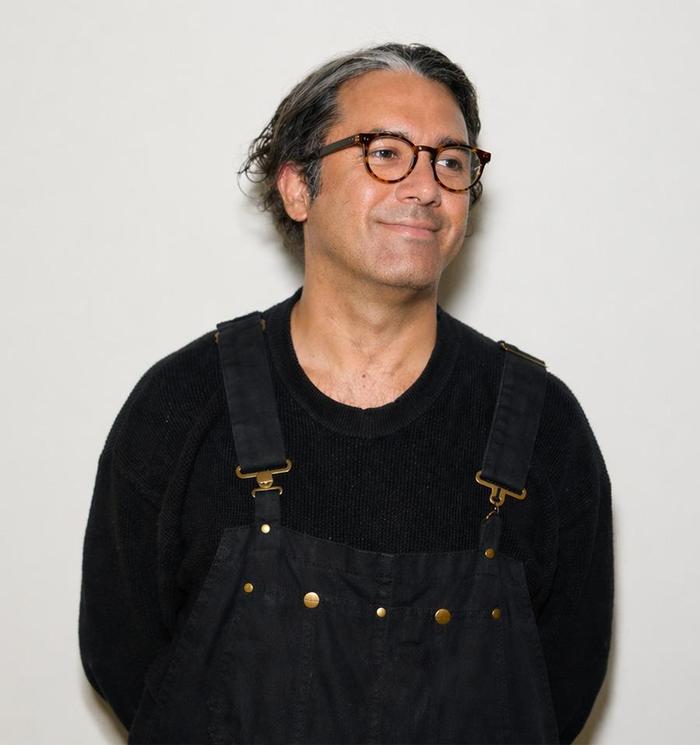
Antonio Dias: Political Modernism from Paraiba to the World
Origins
Antonio Dias was born in Campina Grande, Paraiba, in 1944, and became one of the most important Brazilian artists of the postwar period by refusing to keep painting comfortably silent. From early on, he moved beyond traditional pictorial space and began treating the canvas as a place where image, language, politics, and structure could collide. After formative years in Rio de Janeiro, he entered the international art circuit while still very young, later living in Paris, Milan, New York, Nepal, and Berlin. Yet even as his career expanded globally, the force of his work remained tied to a Brazilian urgency: a need to test how art could register pressure, conflict, censorship, desire, and control without becoming merely illustrative. See also Isabela Leao and the Porcelain Edge of Feeling.
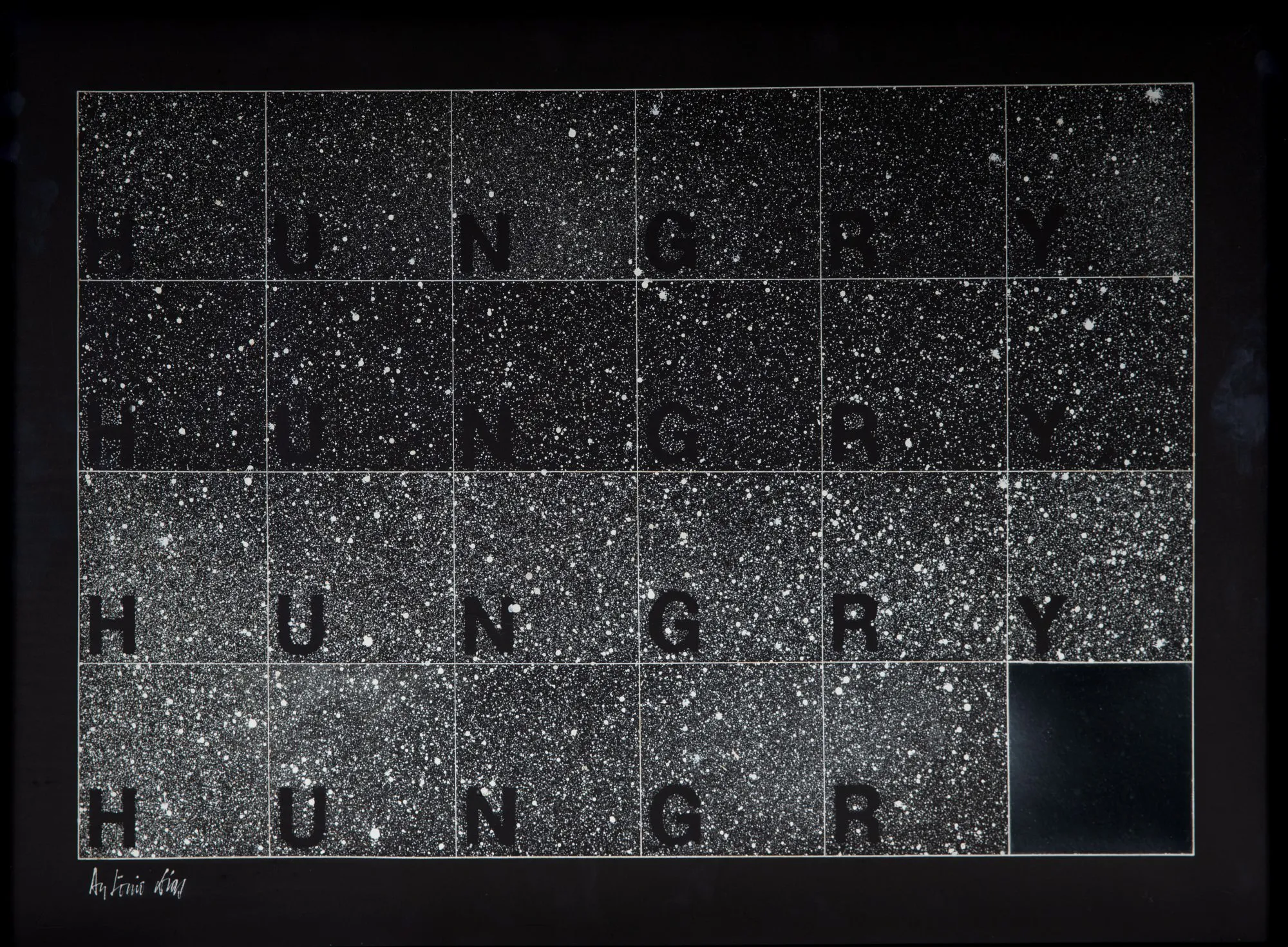
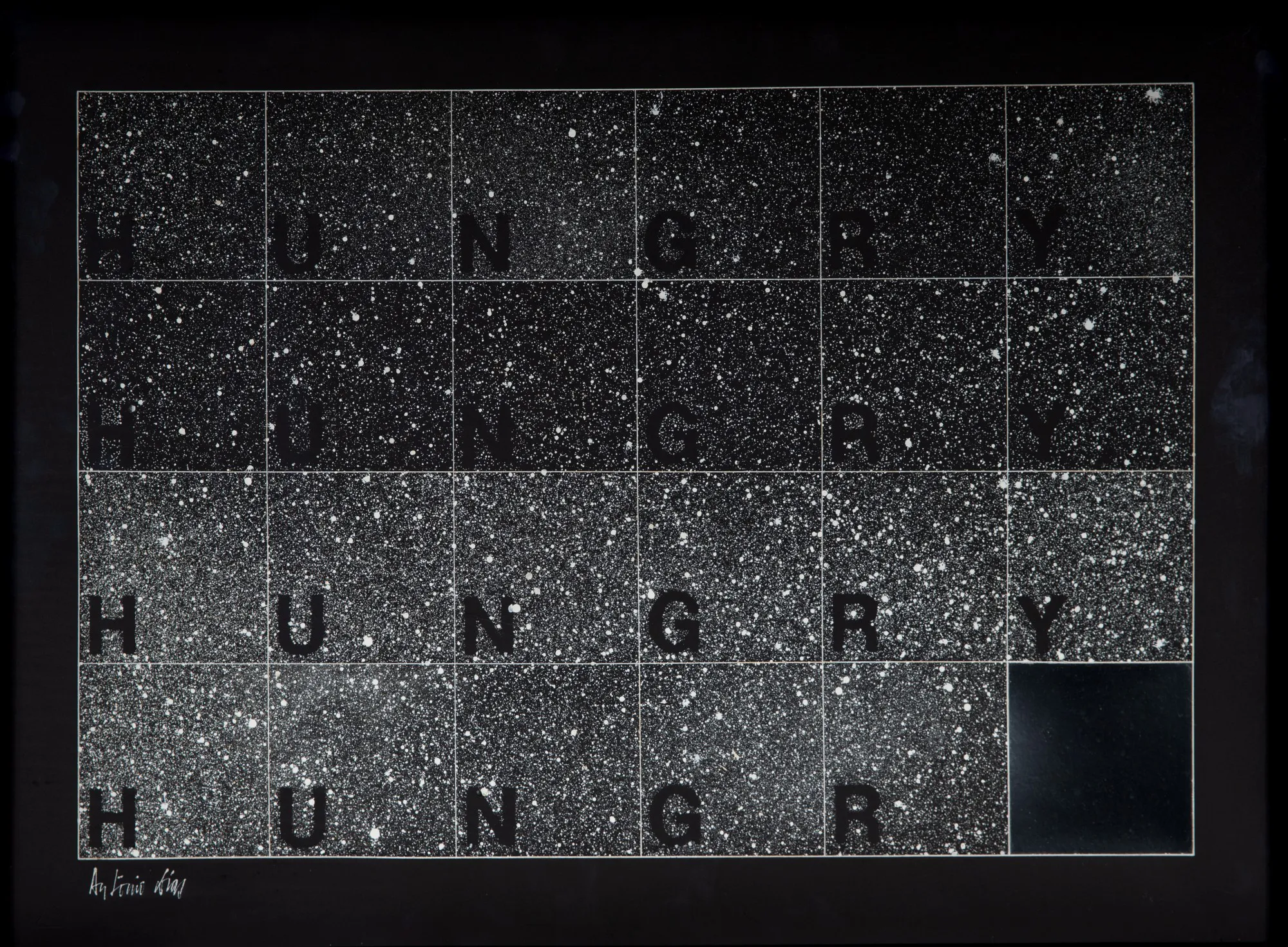
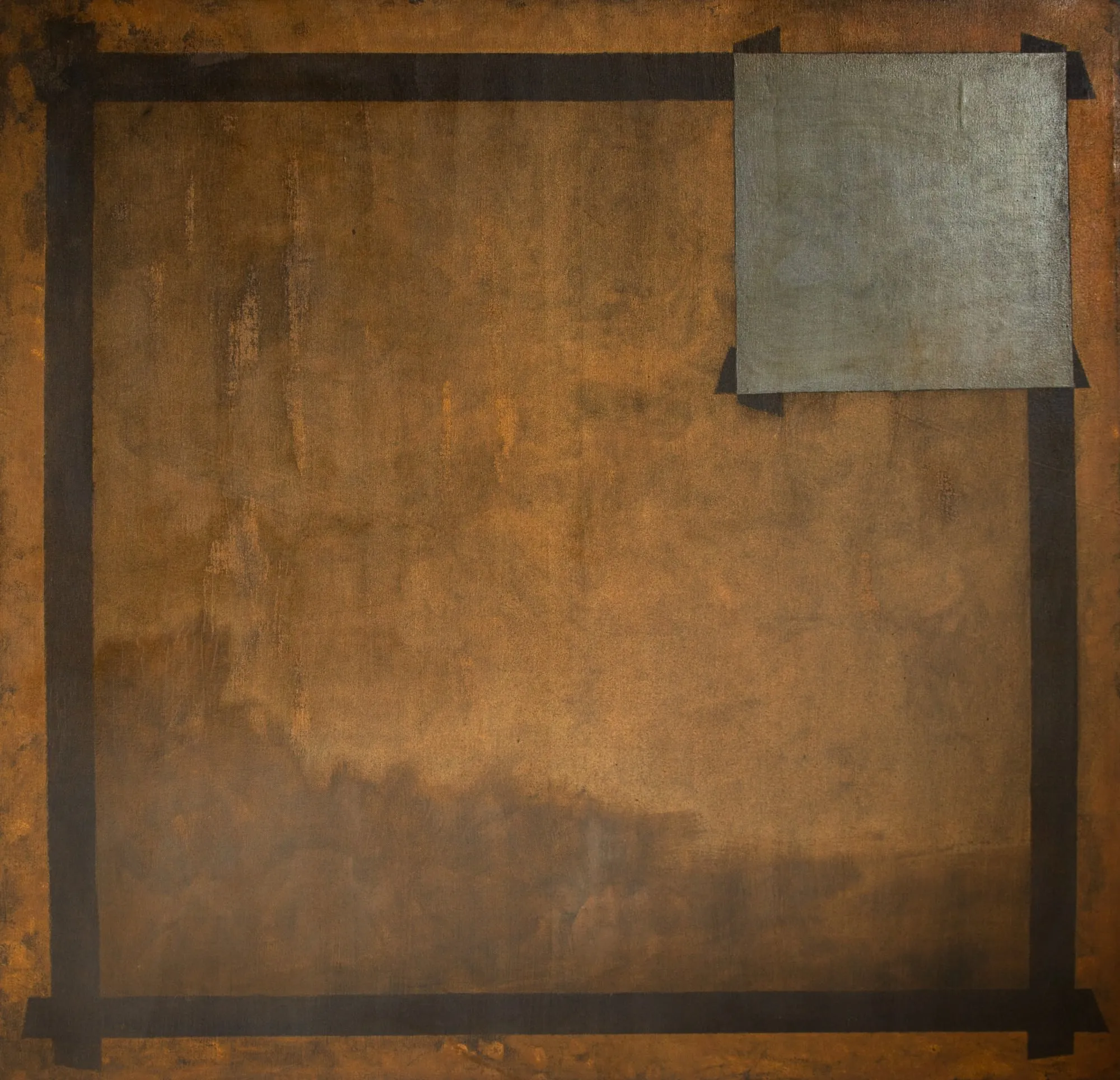
What gives Dias such lasting power is the clarity of his visual intelligence. His works often appear stripped down at first glance, but they are charged with tension. Shapes are placed with precision, surfaces feel deliberate, and words enter not as explanation but as disruption. In paintings from the late 1960s and 1970s, he developed a vocabulary in which abstraction and statement become inseparable. A work like Arid shows how he could make a compressed formal field feel psychologically and politically loaded, while pieces such as Hungry reveal his ability to stage absence, appetite, and command within a tightly controlled image. Even his untitled works are rarely neutral: they feel like systems under pressure, asking the viewer to read both what is shown and what is withheld. See also Delson Uchoa and the Latitude of Color.
Artwork image.
Dias also matters because he expanded his practice without losing rigor. He worked across painting, printmaking, object-based thinking, artist books, music, and conceptual series, but the throughline never disappeared. He was consistently interested in structures of mediation: how meaning is framed, how ideology enters form, how language can both clarify and contaminate an image. Later works using handmade paper and metallic pigment show another side of this intelligence. They are materially rich yet still resistant, never settling into pure decoration. Instead, they hold onto the friction that defines his best work, where elegance and disturbance occupy the same surface. See also Caetano Dias: Unlocking Bahia's Vernacular Canvas.
Artwork image.
For an international reader, Antonio Dias offers one of the strongest entries into modern and contemporary Brazilian art because his work is both historically grounded and astonishingly current. He speaks to dictatorship-era pressure, global circulation, conceptual art, and the instability of images in public life, all while maintaining a singular visual voice. His art does not ask to be admired from a safe distance. It asks to be read closely, argued with, and felt as a field of tension. That is why it endures: not as a regional footnote, but as a major artistic language born in the Northeast and sharpened on a global scale. See also Arthur Bispo do Rosário and the Urgency of Reordering the World.
Fontes:
(1) escritoriodearte.com - https://www.escritoriodearte.com/artista/antonio-dias
Practice and materials
(2) Escritorio de Arte - https://www.escritoriodearte.com/en/artista/antonio-dias
(3) Escritorio de Arte - https://www.escritoriodearte.com/artista/antonio-dias/arid-23871
(4) Escritorio de Arte - https://www.escritoriodearte.com/artista/antonio-dias/hungry-21147
(5) Wikipedia - https://en.wikipedia.org/wiki/Ant%C3%B4nio_Dias
(6) Wikipedia - https://pt.wikipedia.org/wiki/Ant%C3%B4nio_Dias
(7) Wikipedia - https://pt.wikipedia.org/wiki/Antônio_Dias
Imagem de capa: Artwork image.
This article is part of the CASCA Archive, documenting visual artists from Northeast Brazil. Story about Antônio Dias.