Bozó Bacamarte and the Street's Fantastic Anatomy
Origins
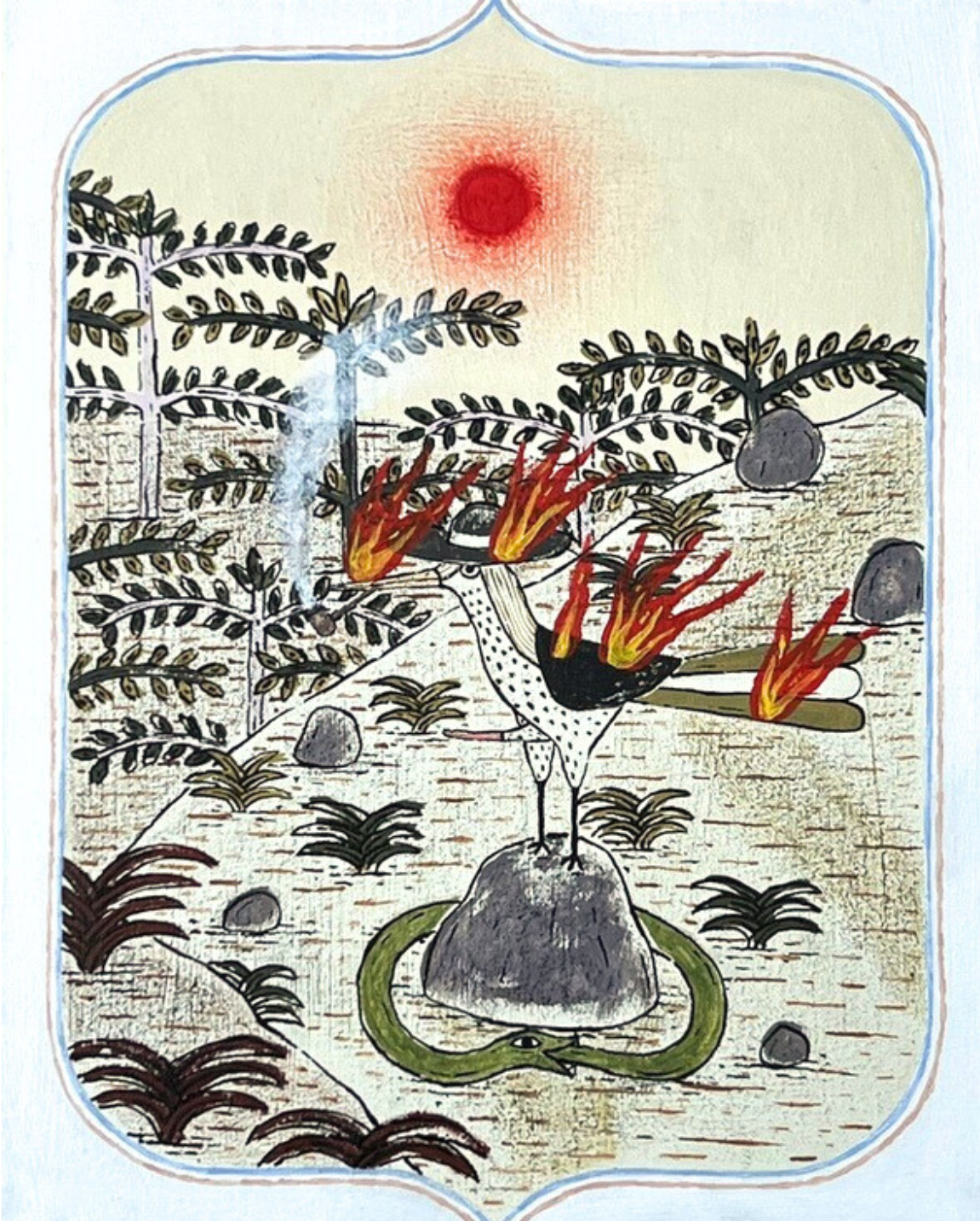
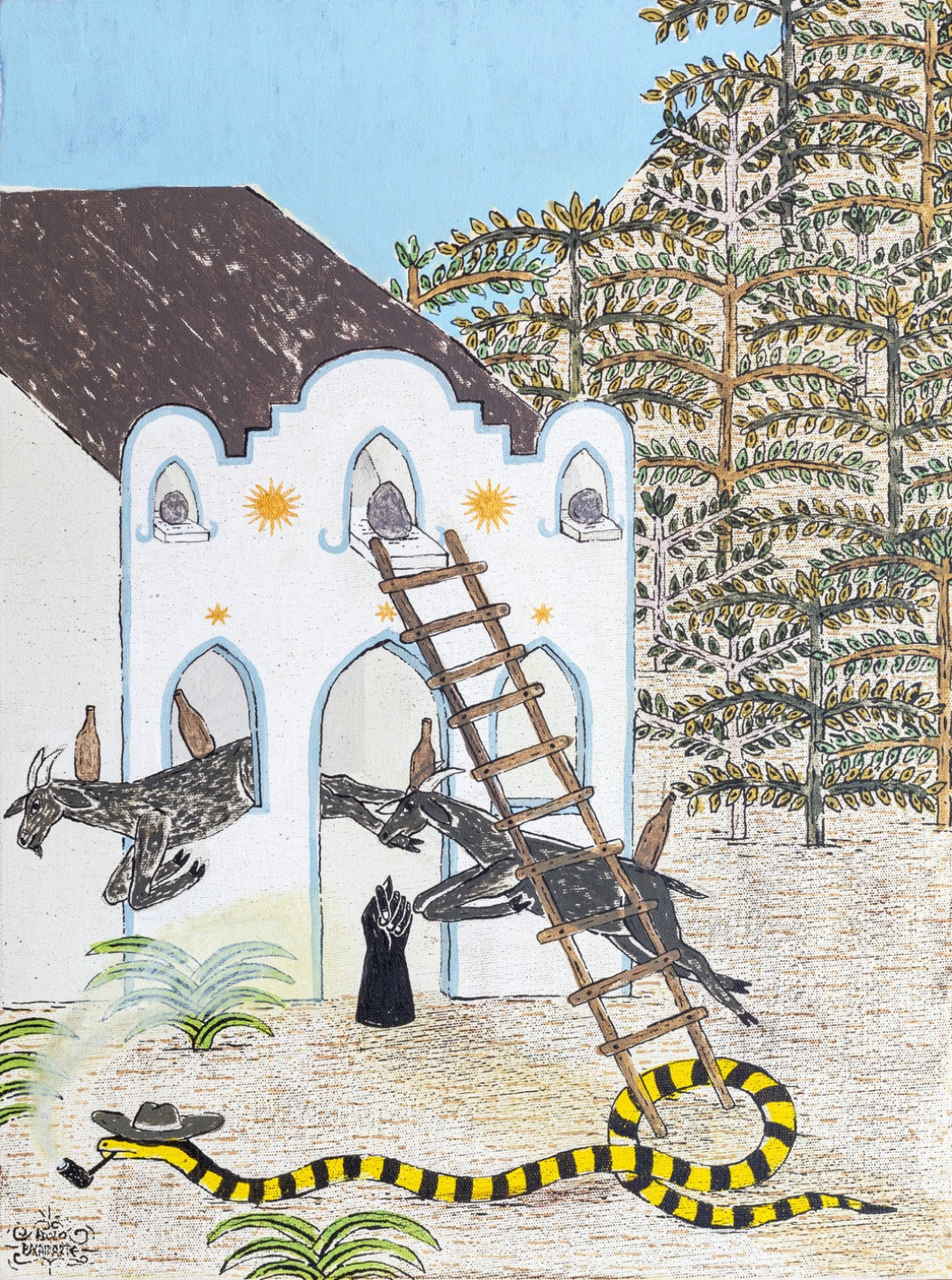
Bozó Bacamarte turns the visual noise of the street into a compact mythology of Northeast Brazil. Born Daniel Ferreira da Silva in Pernambuco in 1988 and associated with Olinda and Recife, he began through graffiti before developing a painterly language anchored in popular woodcut, cordel, hip hop, and the Armorial imagination. His images do not simply quote those traditions; they rewire them. A chapel may lean into a desert of cacti, a serpent may cross a scene like a line of music, and a goat, bird, ladder, stone, or flame can become the active leg of an image’s anatomy, holding the composition upright while also making it unstable. See also Carolina Noemia and the Carnival Line of Recife.
The selected works show how Bacamarte builds that instability with unusual discipline. In the wide landscape reproduced for Sobressalto e Estripulia, the canvas becomes a stage of portals, smoking figures, twisted trees, and animal presences moving under a hard blue sky. The drawing keeps the directness of a print, but the painting refuses to stay flat in feeling. Its humor is not decorative. It arrives through impossible behavior: animals smoke, carry objects, enter architectures, and perform rituals in a dry country that feels both comic and haunted. Bacamarte’s world has the quick legibility of public image-making, yet it also asks the viewer to linger over each strange relation. See also Isabela Leao and the Porcelain Edge of Feeling.
Visual language
That combination comes from a biography shaped by movement between wall and canvas. Sources describe his early fascination with graffiti seen across Recife and Olinda, his formation through the Instituto Vida, and his encounter with Gilvan Samico, J. Borges, cordel, and the Movemento Armorial. The influence is visible less as homage than as structure. Bacamarte often organizes space with a cordel-like planar logic, where what appears above can also feel like what lies behind. In paintings with chapels, ladders, goats, serpents, fire, and sparse vegetation, the scene reads almost as a popular tale already underway. The viewer enters after the first event and before the next one. See also José Altino: Where Stark Lines Reveal the Northeast's Anatomy.
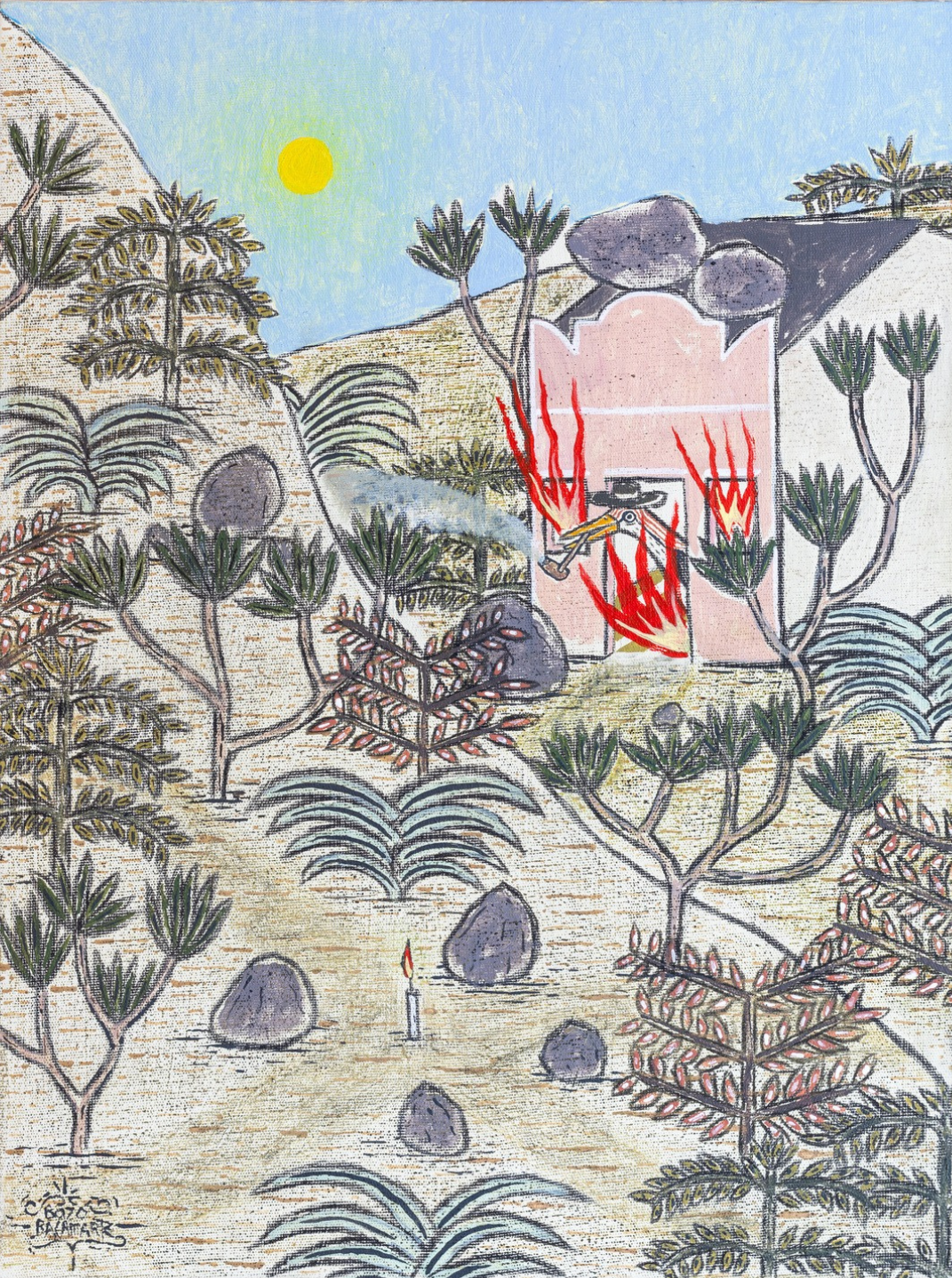
For CASCA Archive, Bacamarte matters because his practice makes contemporary painting speak through popular intelligence without reducing it to folklore. His work carries the street’s appetite for direct communication, the woodcut’s graphic punch, and a fabulatory politics rooted in everyday Northeast culture, religious crossings, humor, and social transformation. The result is not nostalgia for a fixed regional image. It is a living grammar of invention: cangaço-like silhouettes, terreiro energies, agreste plants, circus absurdity, and urban memory rearranged into scenes that feel ancient and freshly improvised at once. Even when a motif returns from one canvas to another, it behaves differently, as if each repetition were testing a new social weather. Bacamarte paints as if the visible world were always about to misbehave, and that misbehavior becomes a serious form of knowledge. See also Mestre Dila and the Woodcut Theatre of the Agreste.