Cordel Does Not Fit in Drawers: Marina Nabuco on the Living Archive of Instituto Brincante
Archive as Listening
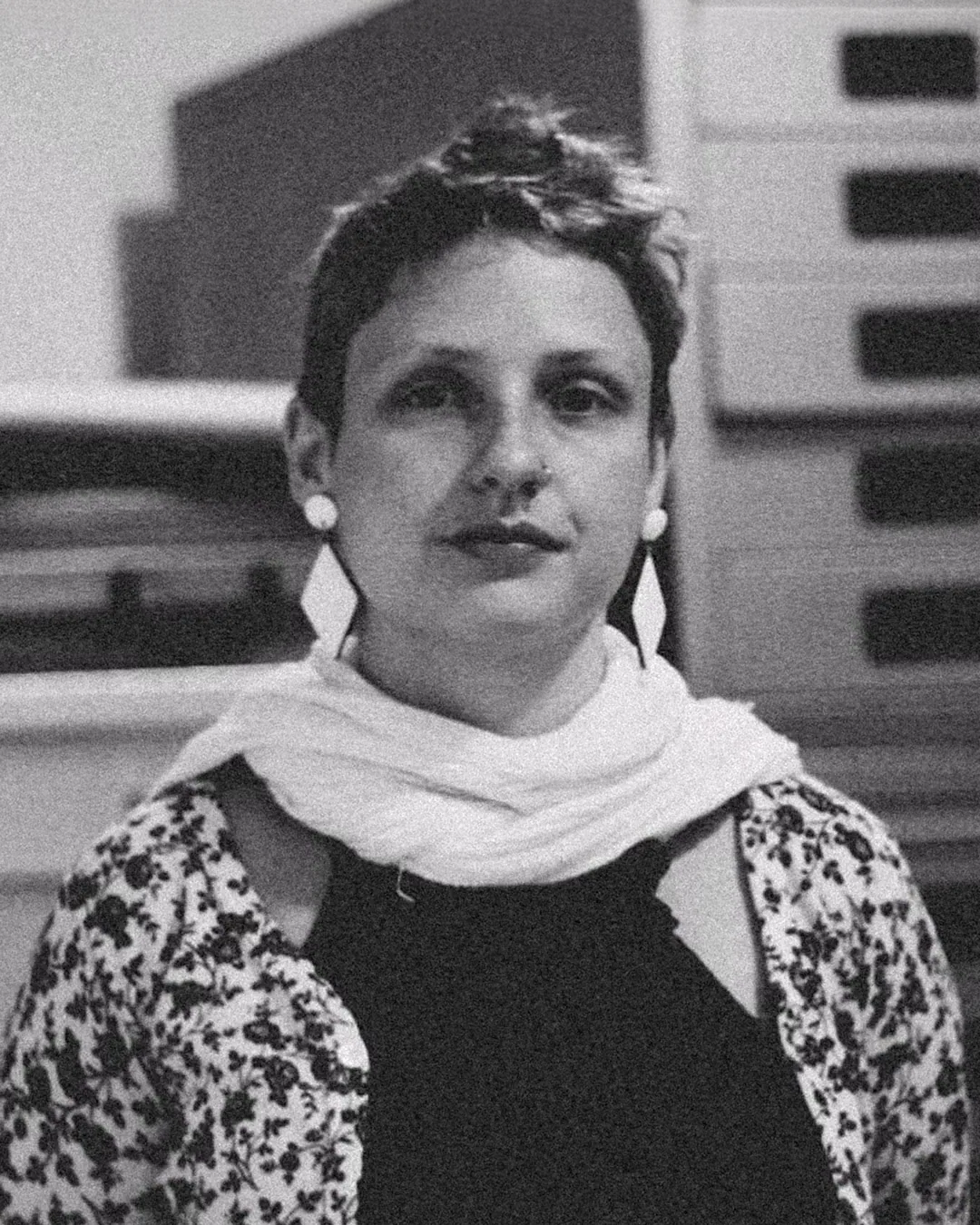
When Marina Nabuco speaks about archives, the conversation never remains confined to the idea of a silent room, removed from the world. For her, preservation also means listening: to paper, printing technique, old spelling, the almost hidden signature of an illustrator, and the way a chapbook passed from hand to hand before reaching a collection. In the case of cordel literature, this care gains another layer, because it deals with an editorial form that has always circulated between the printed page, the public voice, the market, the square, family memory, and the collective imagination. See also Flávio Gadelha: The Quiet Force Shaping Pernambuco Art.
Born in São Paulo, Marina grew up in a family that preserved documents and objects across generations. Memory, before becoming a profession, was already a domestic practice. Later, at ECA-USP, where she earned a degree in Visual Arts with a specialization in Printmaking, she found in image reproduction techniques a field of fascination: accessible, multiple processes capable of making an image travel. But it was also at the university that she noticed an absence. In her woodcut classes, there was a lack of a more consistent approach to Brazilian popular printmaking, especially the kind connected to cordel chapbooks. See also Isabela Leao and the Porcelain Edge of Feeling.
That frustration led her to the Institute of Brazilian Studies at USP, where, in 2015, she took the course Cantoria and Cordel Literature with Professor Paulo Teixeira Iumatti. Marina describes that encounter as the opening of a world. From then on, she began working with cordel collections, first as a volunteer and later as an intern at the IEB Archive, while also developing undergraduate research on the subject. The work was direct and meticulous: cleaning, preventive conservation, documentary description, bibliographic research, and the creation of specific search fields for illustration techniques and biographical information about illustrators. See also Tiago Sant’Ana and the Living Archive of Performance.
The Brincante Collection
This training at the intersection of printmaking, archives, and conservation would prove decisive a few years later, when Marina became connected with Antonio Nóbrega, multidisciplinary artist and president of Instituto Brincante. They met at an event on cordel literature at IEB-USP in 2016. First came small repairs to books from his private library and an exchange of interests around Brazilian popular culture. Later, through a grant from the São Paulo Municipal Department aimed at modernizing collections, the project to organize Instituto Brincante's cordel collection was born. See also Mateus Sá: The Visual Pulse of Brazil's Sacred Territories.
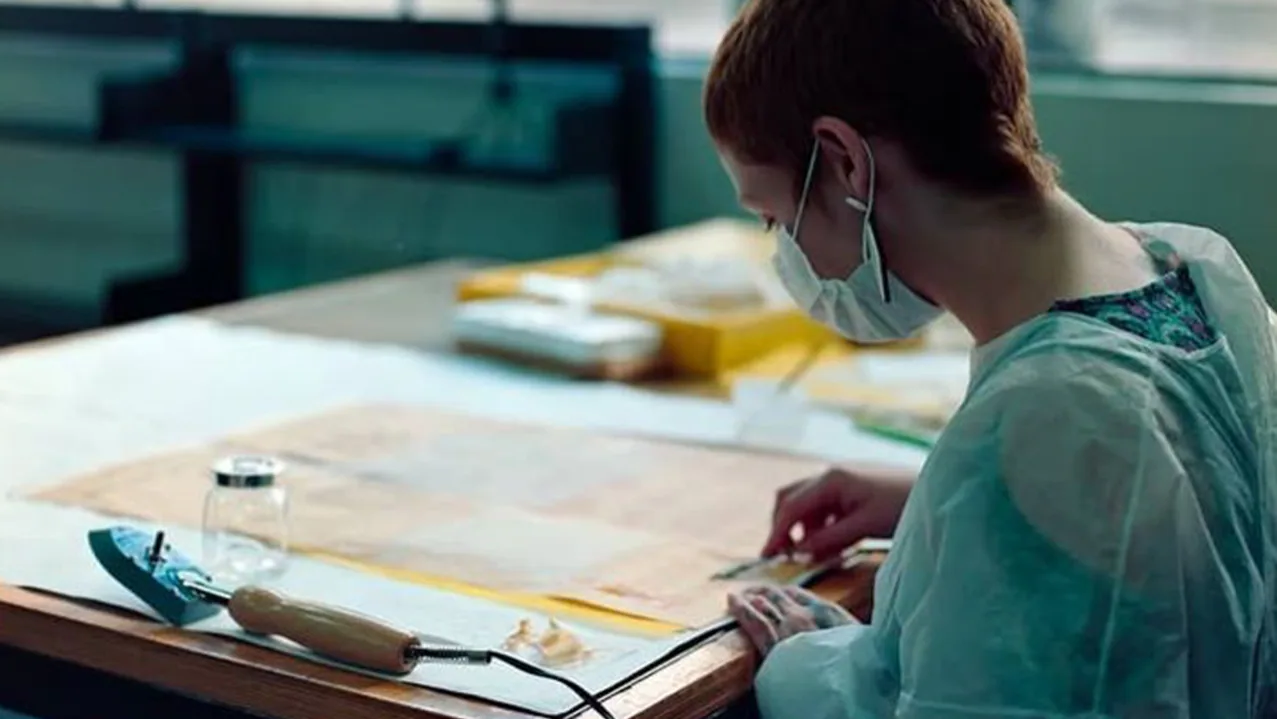
The scale of the collection is impressive: more than five thousand items, gathered throughout Antonio Nóbrega's travels across Brazil and expanded through the acquisition of the collection of journalist Luiz Ernesto Kawall. The project set out to organize, clean, remove metal fasteners from, describe, digitize, and make part of this material freely available to the public. Marina coordinated a small team of only three people responsible for completing all these stages within one year. The team also included Matias Sharif Marcossi and Karoliny Borges, who at the time also worked at IEB; Marcossi, trained in Letras, now works in advertising, while Borges is a historian who also works with archive collections. Around 500 public-domain chapbooks also underwent repairs before being fully digitized. See also José Altino: Where Stark Lines Reveal the Northeast's Anatomy.
The pandemic prevented the launch of the portal from being celebrated in person at Brincante, as originally planned, with poets, researchers, and interested visitors gathered around the collection. Even so, the Antonio Nóbrega Collection Portal went live, opening an important part of the collection to public consultation and creating a research database that can continue to be updated.
Cataloging Without Erasing
Cataloging cordel, however, is far from a neutral or simple operation. The field is too broad, too diverse, too alive. Rather than imposing rigid thematic divisions, Marina and the team chose an organization designed to facilitate research: grouping works by authors in alphabetical order, followed by the ordering of titles. Works whose authorship could not be verified were placed toward the end. When sources diverged, the discrepancies were recorded. When a piece of information could not be confirmed, it was marked as not identified.
The cataloging spreadsheet was divided between the General Collection and Public Domain, since the possibility of full digitization depended on copyright status. Each document received an individual code. The columns included data such as author, title, location, year, publisher or print shop, illustrator, and notes. The method had a practical concern, but also an ethical one: not to invent certainty where there was only a hypothesis.
It is at this point that the technical work approaches a kind of sensitive reading. For Marina, cataloging is interpretation. A name may be a pseudonym. A signature may vary. A word may carry the spelling of its time, a regional expression, a pun, or a reference that only makes full sense in its original context. For this reason, the team copied the titles as they appeared in the documents and, when necessary, added the updated spelling in parentheses. In this case, the archive does not correct the object; it tries to build bridges so that it can be found without erasing its original form.
Paper, Woodcut, and Circulation
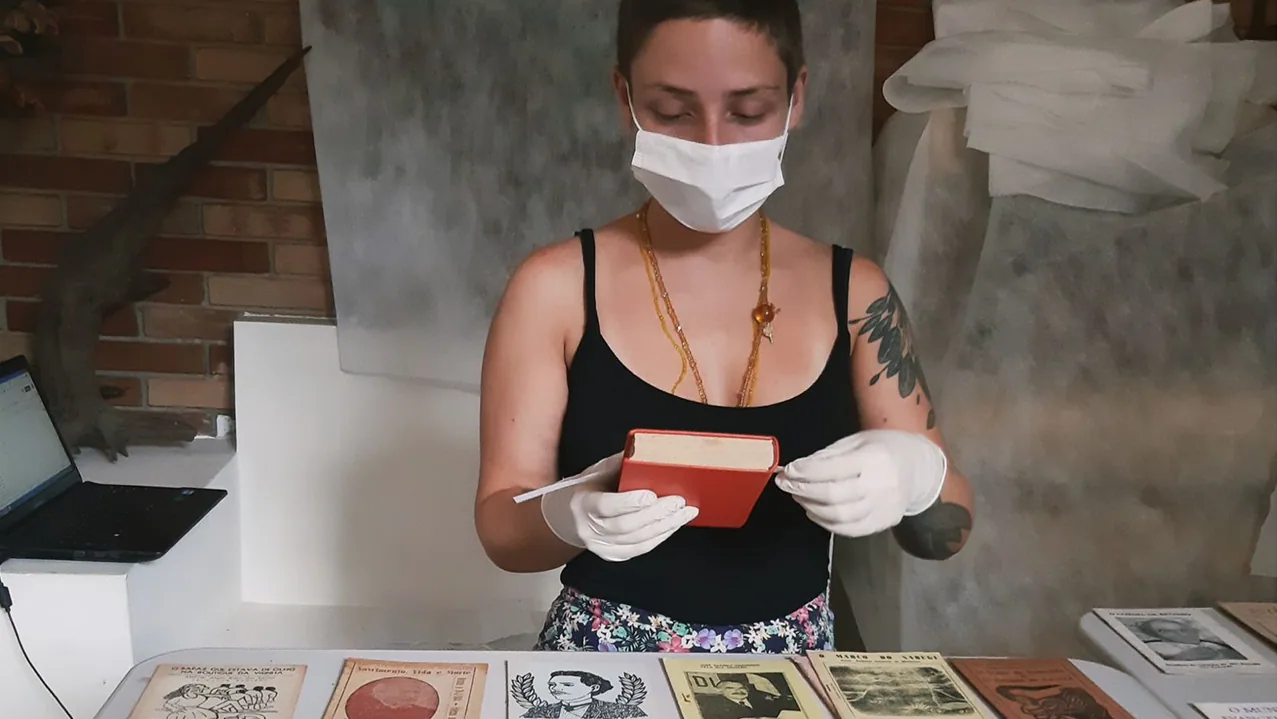
The materiality of the chapbooks also tells a story. In dealing with publications from different periods, Marina observes transformations in visual language, papers, printing techniques, and methods of composition. The woodcut, now so strongly associated with the imagery of cordel, was not always dominant. According to her, its wider popularization on chapbook covers occurred mainly from the 1950s and 1960s onward, driven in part by academic interest in the technique. Before that, metal plates from publishers in capital cities were common, often featuring images from European cinema or theater, along with techniques such as drypoint zincography.
The paper also changes. Older chapbooks often used acidic newsprint made from mechanical pulp, while later productions frequently began using offset bond paper made from treated eucalyptus cellulose. These differences are not merely technical: they determine how the documents age, how they should be handled, and what kinds of care they require. Cheap materials, designed for wide circulation and low cost, tend to degrade more quickly. Before going to the scanner, many chapbooks had to be repaired and sewn to prevent further damage.
This attention to the physical object prevents digitization from being treated as a substitute. On the portal, the public-domain chapbooks are fully digitized; the others have restricted access, respecting copyright. Instituto Brincante also welcomes researchers, schools, and visitors interested in consulting the collection in person. For Marina, nothing replaces the experience of holding the chapbook, sensing its size, its paper, its fold, and its fragility. The high-resolution image expands access, but the body of the document continues to say things that the screen does not fully convey.
Even so, the digital realm opens important paths. The website was designed to offer large images, clear information, adequate contrast, legibility, and fewer barriers to access. Future plans include transcribing the contents and implementing accessibility tools, such as interpretation in Libras through digital resources. The goal is not only to preserve, but to keep things circulating.
A Graphic History from the Margins
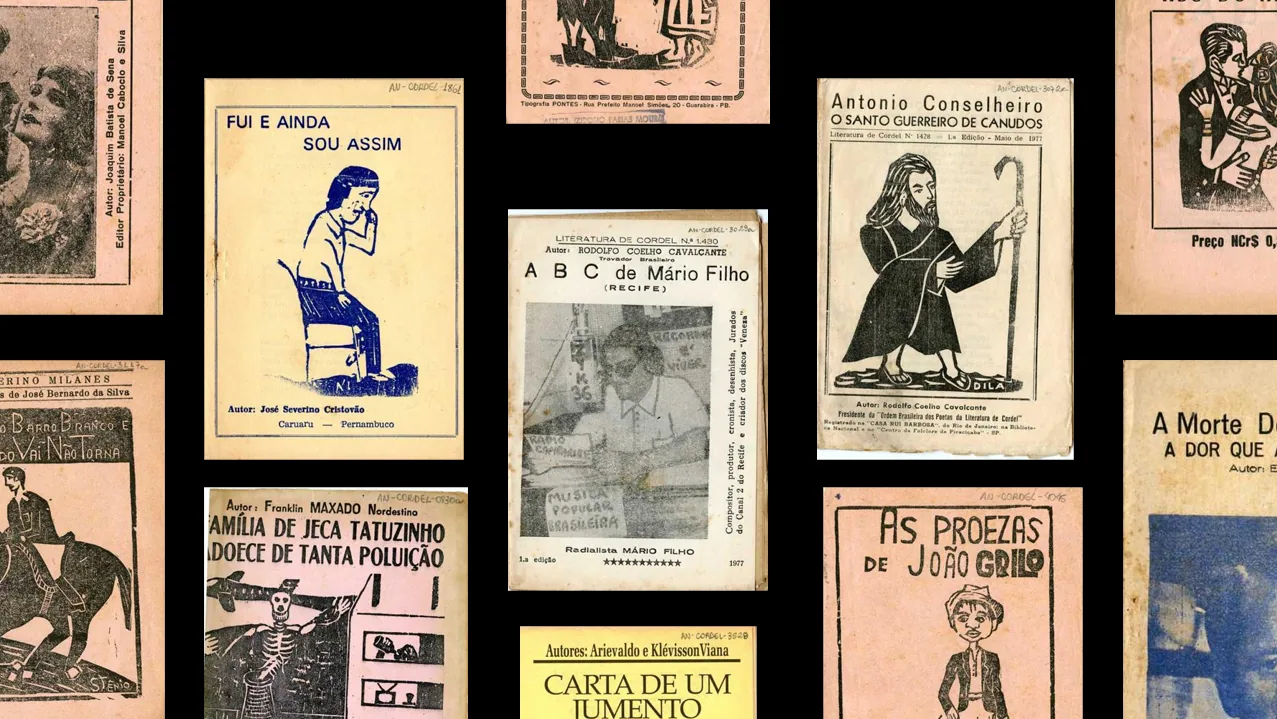
The covers occupy a special place in this universe. They form a fundamental chapter in the history of Brazilian popular graphic design. Although she was not able, in this first stage, to include all the illustration techniques in Brincante's database, Marina made a point of carefully recording the illustrators, researching birth names, signatures, initials, and artistic names. Artists such as J. Borges, Dila, Abraão Batista, and Stênio Diniz appear not merely as authors of isolated images, but as part of localized visual traditions, with differences in school, region, technique, and repertoire.
Marina points, for example, to distinctions between productions associated with Caruaru and Pernambuco, generally connected to more graphic and stylized forms, and those from Juazeiro do Norte and Ceará, often more detailed and realistic. These are porous categories, but useful for perceiving how an image carries community, territory, and learning. Even the wood used for the printing block could reveal information about locality, technique, and individual preference, a piece of data she would like to see incorporated into future research.
When cordel is viewed through this lens, Brazilian graphic history also shifts. Brazil's editorial landscape is not limited to the Rio-São Paulo axis, nor to the forms consecrated by the university, the market, or museums. The chapbooks reveal an independent, low-cost production with an enormous capacity for circulation. In regions marked by high illiteracy rates, the poetic structure of cordel facilitated memorization and oral transmission. A chapbook could be bought by a literate person and read aloud to an entire family or community. It could narrate political events, news, religious stories, romances, poetic duels, local events, and worldviews.
This circulation makes cordel not only literature, but also a graphic, informational, and critical vehicle: a social technology of editing and distribution, a form of publishing before publishing became synonymous with a centralized publisher, a bookstore, or an institutional catalog. For Marina, including cordel in the country's literary and visual history is not an act of condescension, but of correction. It is about recognizing a sophisticated, inventive production that has been historically marginalized by social hierarchies disguised as cultural categories.
That is why the separation between popular and erudite appears, in her speech, as a political issue. The problem does not lie in the difference between forms of production, but in the unequal access to funding, preservation, remuneration, presence in institutions, education, and the market. When so-called popular works are treated as lesser, folkloric, or merely regional, we lose the chance to see their formal complexity and critical force.
Preservation as Continuity
The Instituto Brincante collection works against this erasure. It gathers documents, but also creates conditions for new readings. It can serve researchers, designers, artists, teachers, poets, and students. It can inspire graphic, editorial, musical, theatrical, and cinematic reinterpretations. Marina mentions everything from the Armorial Movement to contemporary authors, relatives of cordel masters, musicians, and audiovisual productions that continue to draw from this source.
Preserving, in this sense, is not freezing. It is ensuring that the practice remains available to be studied, challenged, remade, and carried forward. Cordel has always appropriated the tools of its time: typography, woodcut, the square, song, the microphone, cinema, television, the internet. A digital collection does not close this history; it merely offers another surface through which it can circulate.
In the end, Marina Nabuco's work reveals that a chapbook is never just a chapbook. It is paper, ink, cut, stitching, voice, authorship, pseudonym, wood, spelling error, editorial choice, economy, territory, memory. Cataloging it requires rigor, but it also requires humility before an object that does not fit so easily into drawers, labels, or ready-made categories.
And perhaps that is precisely where its permanence lies. Cordel crosses generations because it has never depended on a single form in order to exist. It is printed, sung, read, kept, scanned, reinterpreted. It remains attentive to the present, as it always has been. The role of the archive is to ensure that, as it changes medium, it does not lose its depth.
Source material: interview sent with Marina Nabuco. Instituto Brincante is located at Rua Purpurina, 412, Vila Madalena, São Paulo. More information is available at institutobrincante.org.br.