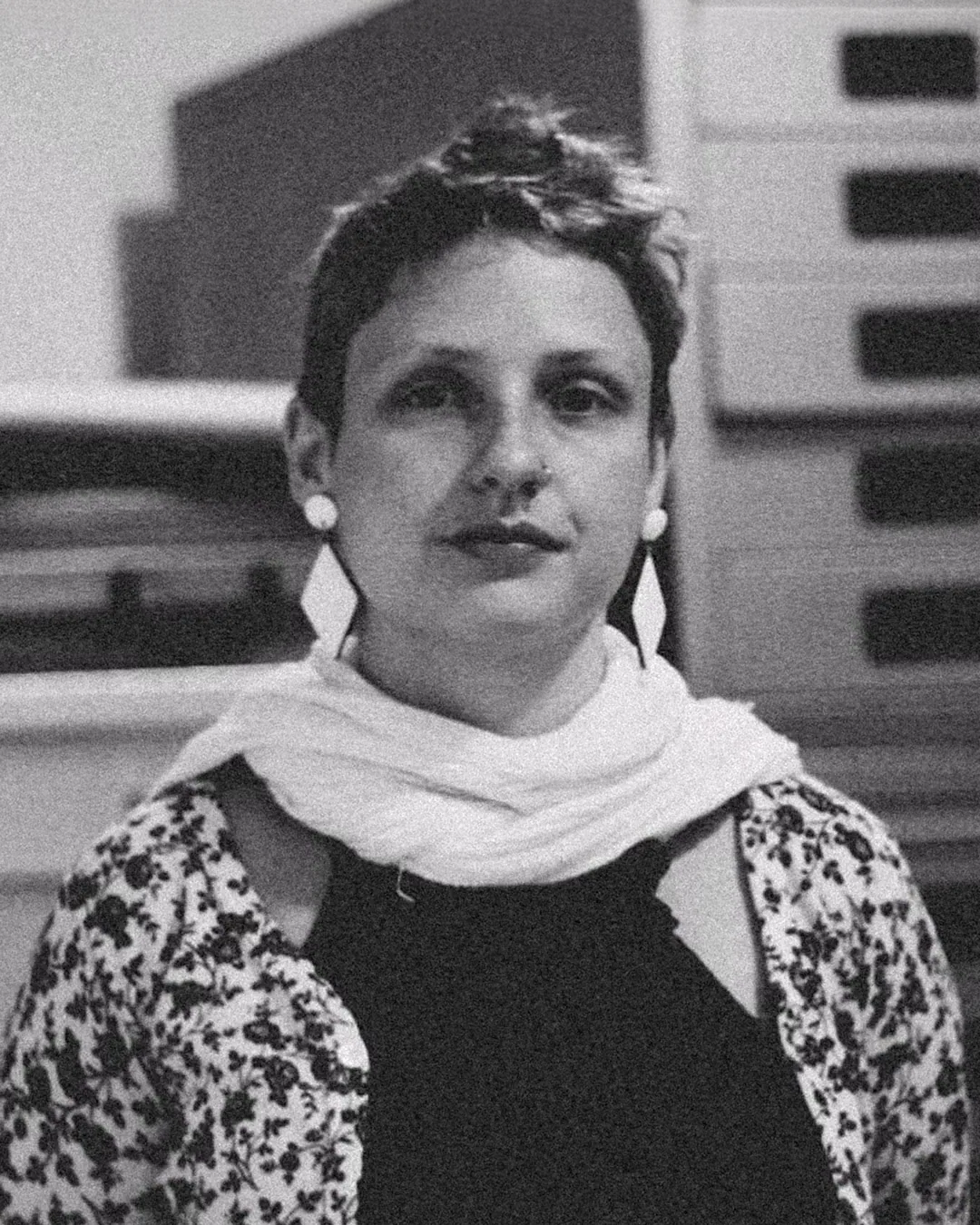
Silvio Zanchetti and the Geometry of Night
Origins
Silvio Zanchetti's painting begins with a trained eye for structure. Born in Sao Paulo in 1952, and identified in Arte Plural Galeria's records as Silvio Mendes Zancheti, he was formed in architecture and spent thirty-five years working as a university professor, urbanist, and conservator of heritage sites before becoming a full-time artist in 2015. That biography matters because his images do not treat abstraction as escape. They read like plans, maps, fragments of terrain, and atmospheric diagrams in which the built world, memory, and interior weather are compressed into fields of color. See also Cordel Does Not Fit in Drawers: Marina Nabuco on the Living Archive of Instituto Brincante.
The five selected works show a practice moving between paper, digital image, and a language of constructed space. A Velha Noite, an acrylic painting on Canson Montval paper, carries the strongest narrative clue: the gallery describes it as a night that repeats eternally in cycles and orients the sertanejo within a primitive and tragic religious vision. The square format becomes almost cosmological. Its geometry does not close the image down; it gives rhythm to a feeling of return, ritual, and time. Rias II and Agitavam as longas Crinas Ondulantes - I, both acrylic paintings on paper, extend that sense of movement into longer horizontal fields, where color and line seem to behave like currents, coastlines, hair, wind, or topographic pressure. Their scale also changes the viewer's pace, asking the eye to travel instead of simply recognize. See also Gabriel Petribu and the Unplanned Geography of Matter.

Public collections
Zanchetti's background in architecture appears less as literal building than as spatial discipline. In Sem tempo 3, a unique digital painting on canvas, the title removes the image from chronological order and places it in suspension. A Aldeia, made with ink and watercolor on paper, brings the vocabulary back toward settlement, community, and the fragile signs by which a place becomes legible. Across these works, his surfaces hold a productive tension between control and disturbance: grids and contours appear, but they never become merely technical. They are crossed by color, mythic suggestion, and the feeling that landscape is also a mental construction.

For CASCA, Zanchetti is interesting because his work connects abstraction to lived geography rather than to formalism alone. The images gathered here move through night, village, water, motion, and timelessness, but they do so through a vocabulary shaped by drawing, planning, and preservation. His paintings ask how a place is remembered when it is no longer represented as a scene. Instead of depicting a sertao, a village, or a shoreline directly, he builds visual conditions around them: repetition, orientation, density, drift. That makes the work especially valuable in a conversation about Brazilian visual memory, where places often survive through signs, rhythms, and inherited systems of orientation. The result is a body of work where architecture becomes atmosphere, and where the image keeps searching for the hidden order inside experience.