Jorge Souza and the Weight of Looking
Jorge Souza, an artist from Gravatá in Pernambuco, began his artistic trajectory in 2018 after training in architecture. That background remains perceptible in the way he constructs an image: figures occupy carefully measured spaces, surfaces function like walls or stages, and every object seems positioned within a larger emotional plan. Working primarily across painting and sculpture, Souza uses oil on canvas, ceramics, porcelain, and resin to investigate the body, desire, memory, beauty, and the pressures that society places on individual experience. His relatively recent career already reveals a coherent language—figurative, theatrical, and attentive to the uneasy distance between what a person displays and what remains concealed. See also Silvana Mendes and the Radiant Repair of the Colonial Archive.
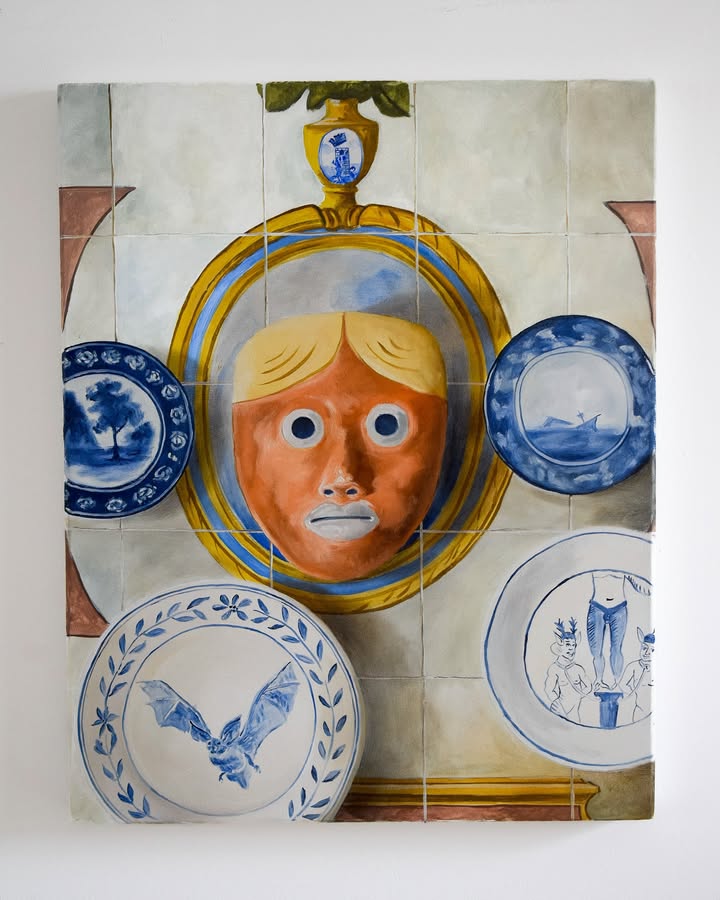
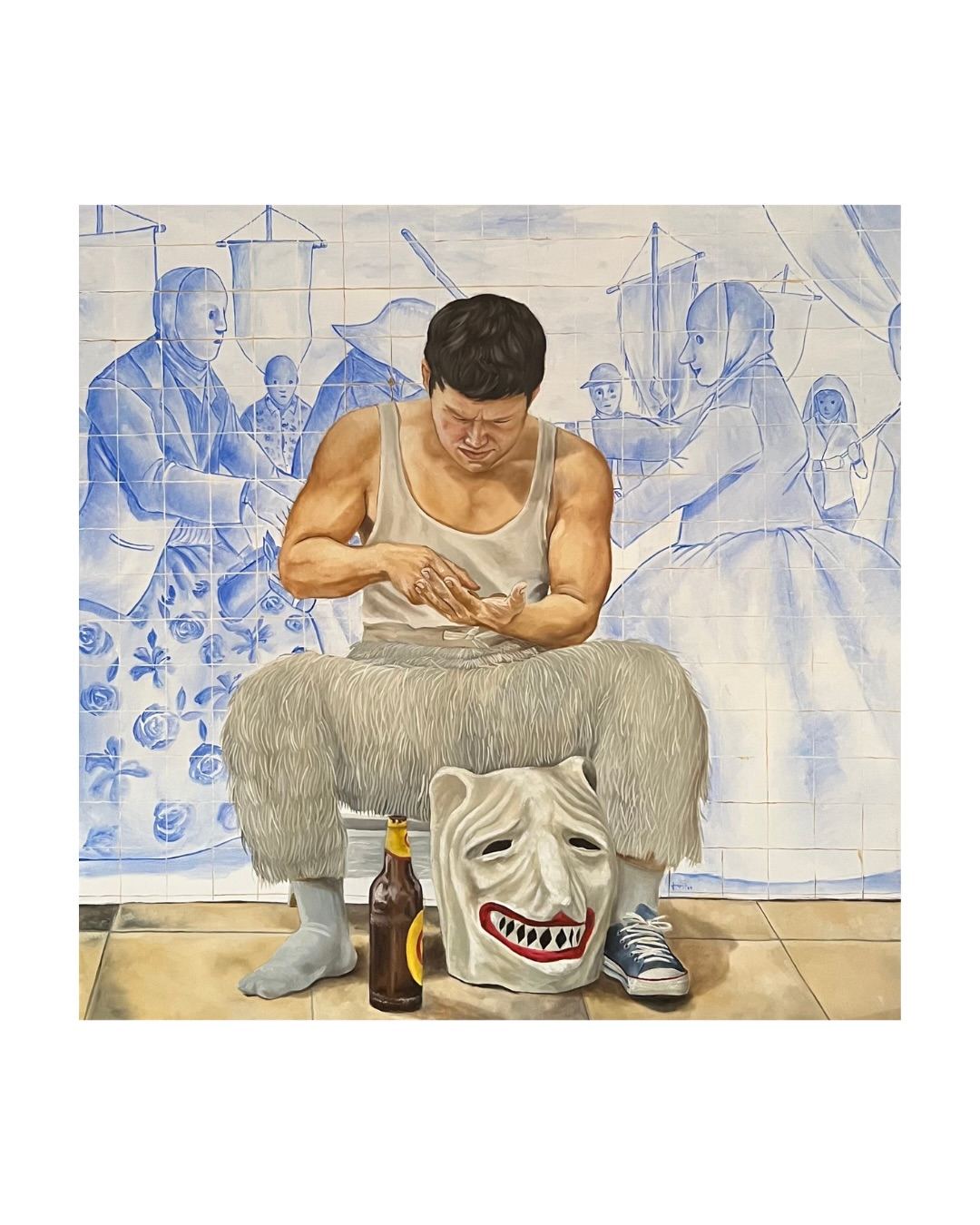
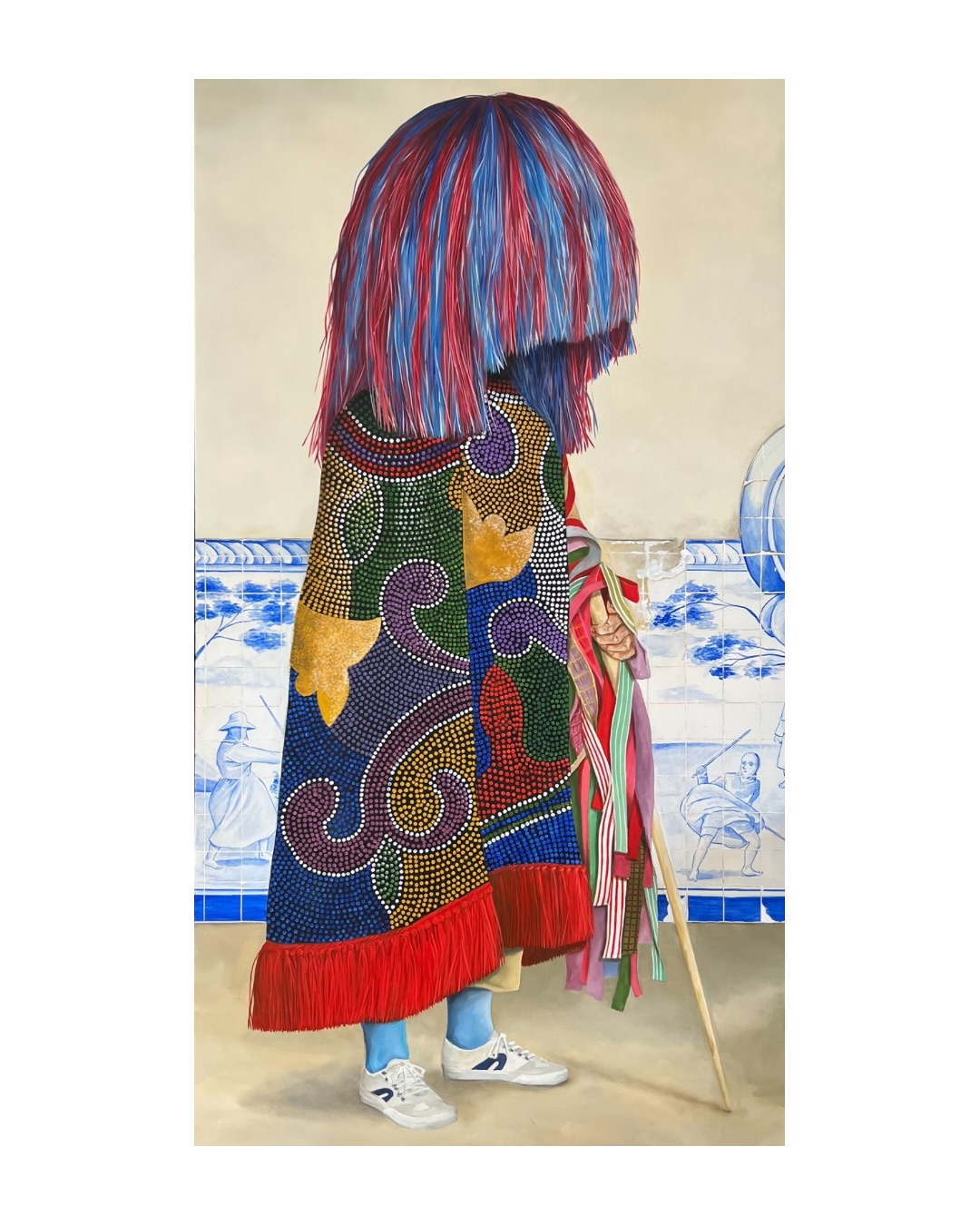
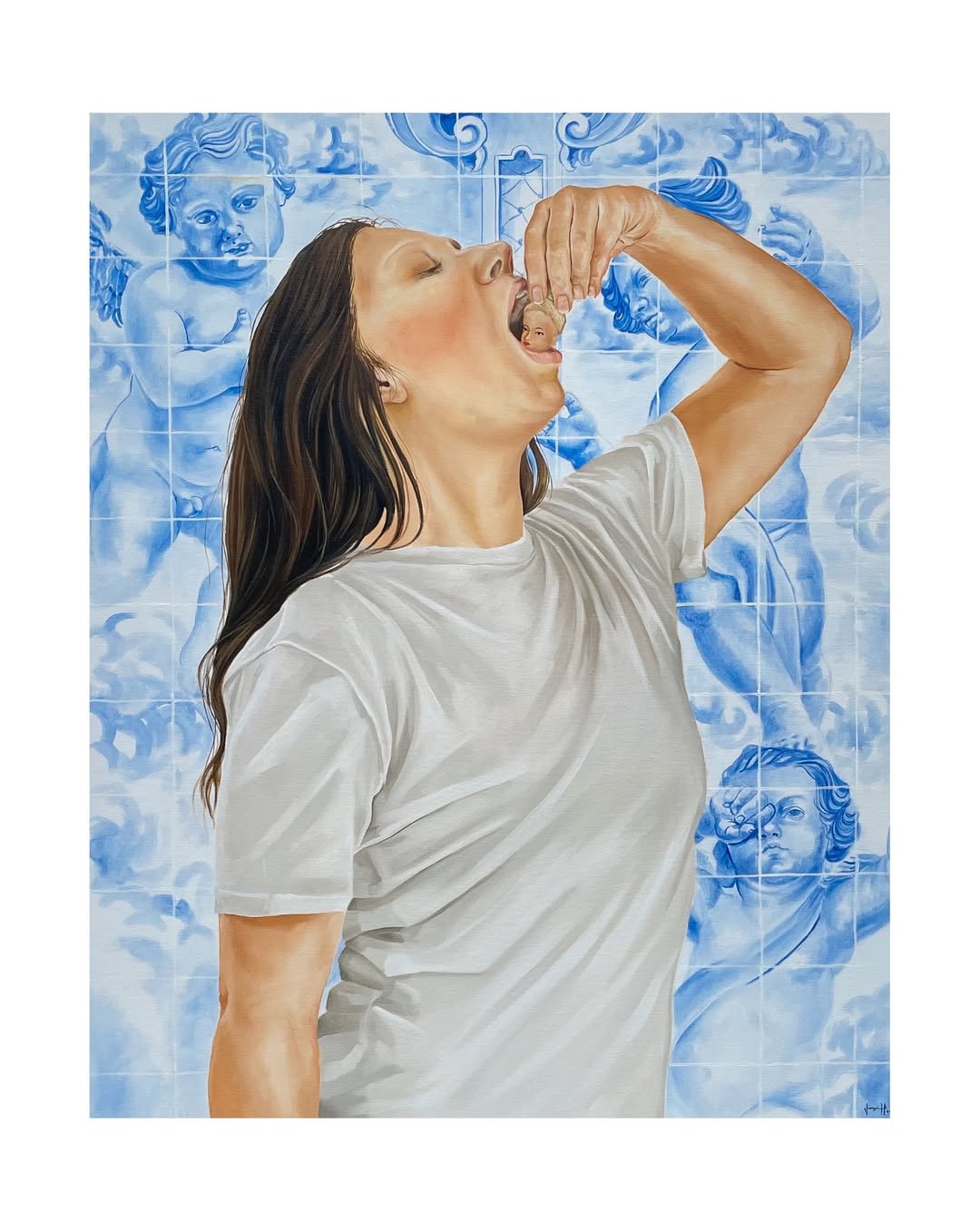
The four works selected here stage that tension through bodies and objects placed against blue-and-white tile imagery. In one, a figure disappears beneath a dense, multicolored costume whose elaborate surface competes with the historical scenes behind it. In another, a seated man examines his hand while a mask rests between his feet, turning costume into something temporarily shed but never fully escaped. A third figure raises a tiny object toward her open mouth as cherubs and fragments of inherited iconography accumulate behind her. The fourth brings a mask-like face into an arrangement of plates, vessels, animals, and architectural fragments. These scenes are rendered with contemporary immediacy, yet their settings summon devotional art, domestic ornament, and colonial visual memory. The tiled backgrounds do not simply decorate the works; they operate as archives against which private gestures and symbolic objects become charged. See also Aurelino dos Santos and the City as a System of Signs.
Souza's work repeatedly asks how identity is performed through surfaces. Clothing, masks, porcelain, skin, and painted tile can protect, beautify, classify, or expose. The artist's movement between oil painting and fired materials strengthens this inquiry: canvas can imitate the gloss and segmentation of ceramic, while vessels and plates turn familiar household forms into carriers of psychological narrative. In the 2024 exhibition O Traçado, Lança Galeria described his figurative art as marked by something ancient, sad, and tense, noting that stories often hide in the relationship between figure and ground. Works presented there—including the oil painting Doce Colheita I, the ceramic panel Doce Colheita II, watercolors, porcelain plates, and the ceramic vessel Fiz de mim o que não soube—demonstrate how fluently he moves between image and object.
Memory in Souza's practice is therefore not a stable record. It is a material that can be tiled, glazed, costumed, repeated, and revised. His figures inhabit the friction between inherited narratives and present-day desire, carrying the visual weight of religion, family, regional culture, and social expectation without becoming illustrations of any single theme. That complexity has placed his work in the collections of the Museu de Arte Moderna Aloísio Magalhães (MAMAM) and Usina de Arte, both in Pernambuco. From Gravatá, Souza is building a body of work in which beauty never arrives without ambiguity: the decorative becomes psychological, the intimate becomes public, and looking itself becomes a negotiation between recognition and disguise.