Thiago Martins de Melo: Repainting Brazil Against Erasure
Thiago Martins de Melo approaches painting as a struggle over who is allowed to appear in history. Born in São Luís, Maranhão, in 1981, and trained to the level of a master’s degree in Psychology, he has built a practice spanning painting, sculpture, installation, and stop-motion animation. His works are immediately recognizable for their physical intensity: thick, luminous paint; crowded scenes; abrupt shifts of scale; and sculptural elements that push beyond the picture plane. Yet their apparent excess is carefully constructed. Martins de Melo researches and plans each composition, assembling figures, objects, myths, and political references into images that ask how Brazil’s past continues to organize violence in the present. See also Gabriel Archanjo and the Figure as a Field of Resistance.
His paintings renew the tradition of history painting by reversing its traditional authority. Rather than celebrating the state, conquest, or official heroes, he writes from a personal and insurgent position. Indigenous peoples, quilombola communities, Afro-Brazilian spiritual entities, rural workers, and other subjects marginalized by dominant narratives become central agents. Chainsaws, firearms, industrial ruins, poisoned water, and violated bodies coexist with mangroves, serpents, enchanted beings, ancestral guardians, and emblems of collective resistance. Popular visual sources—including comics, film posters, games, devotional imagery, and news photographs—enter the work alongside references to Amerindian cosmologies and Afro-Brazilian religions. Accumulation is not decoration here; it is an argument that no single image can contain the layered histories of expropriation and survival. See also Silvana Mendes and the Radiant Repair of the Colonial Archive.
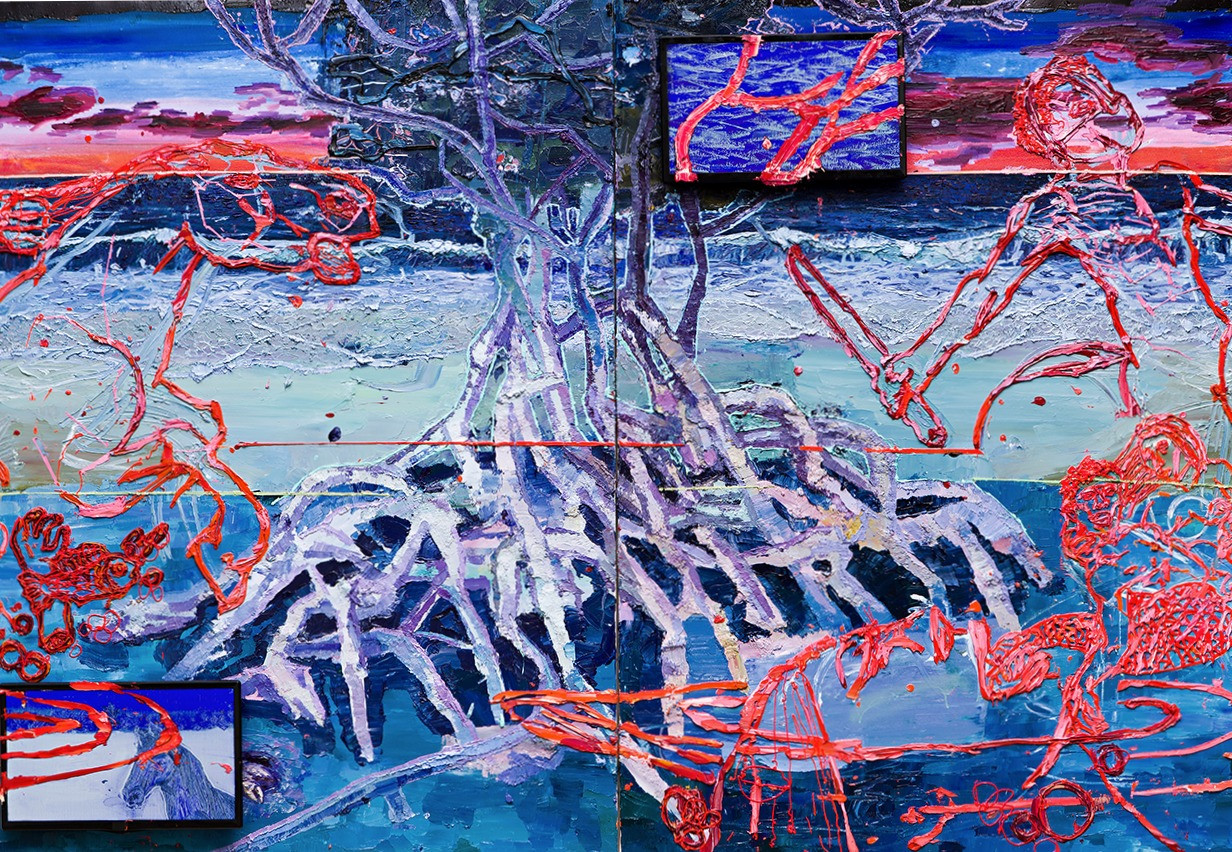
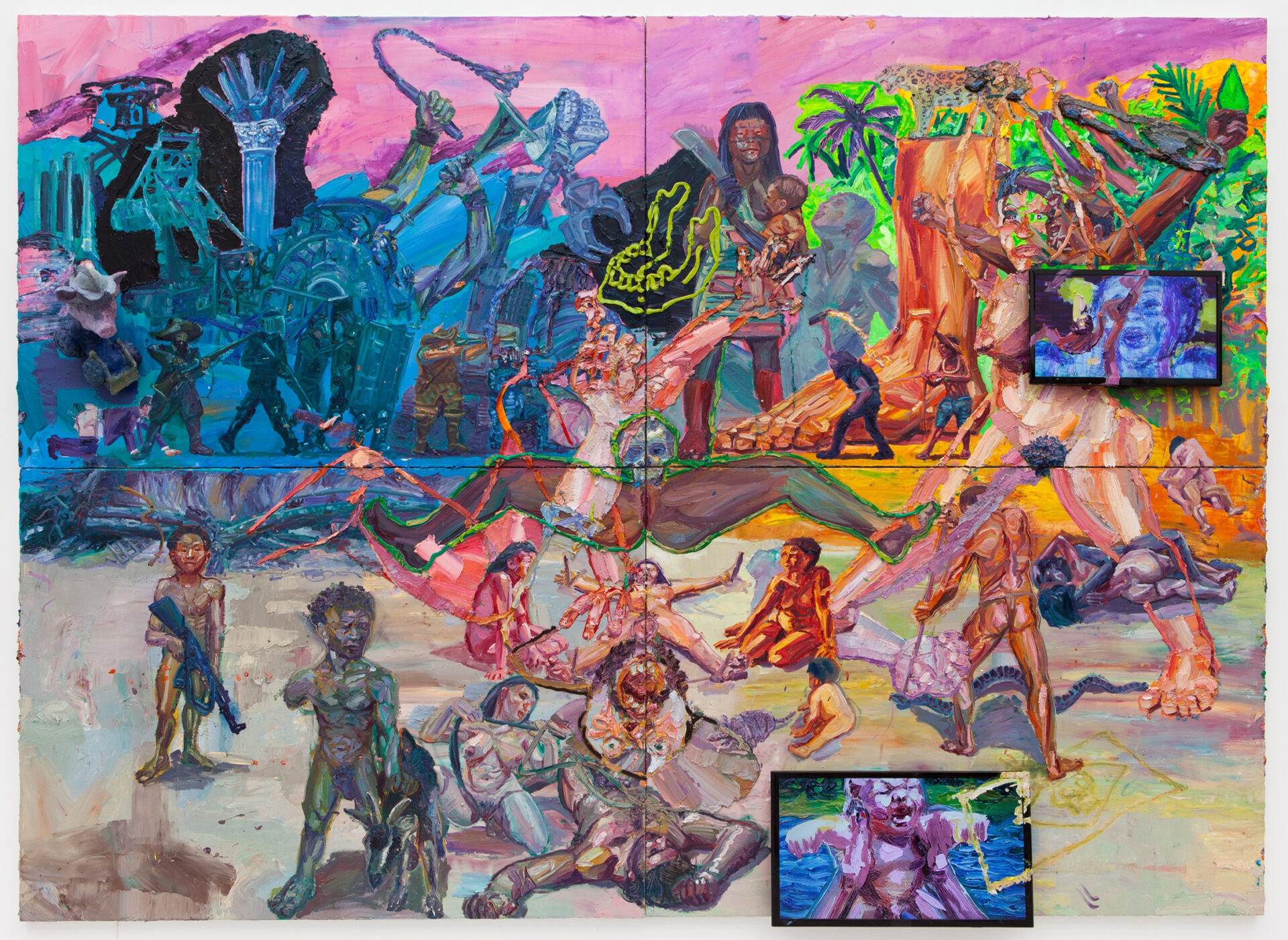
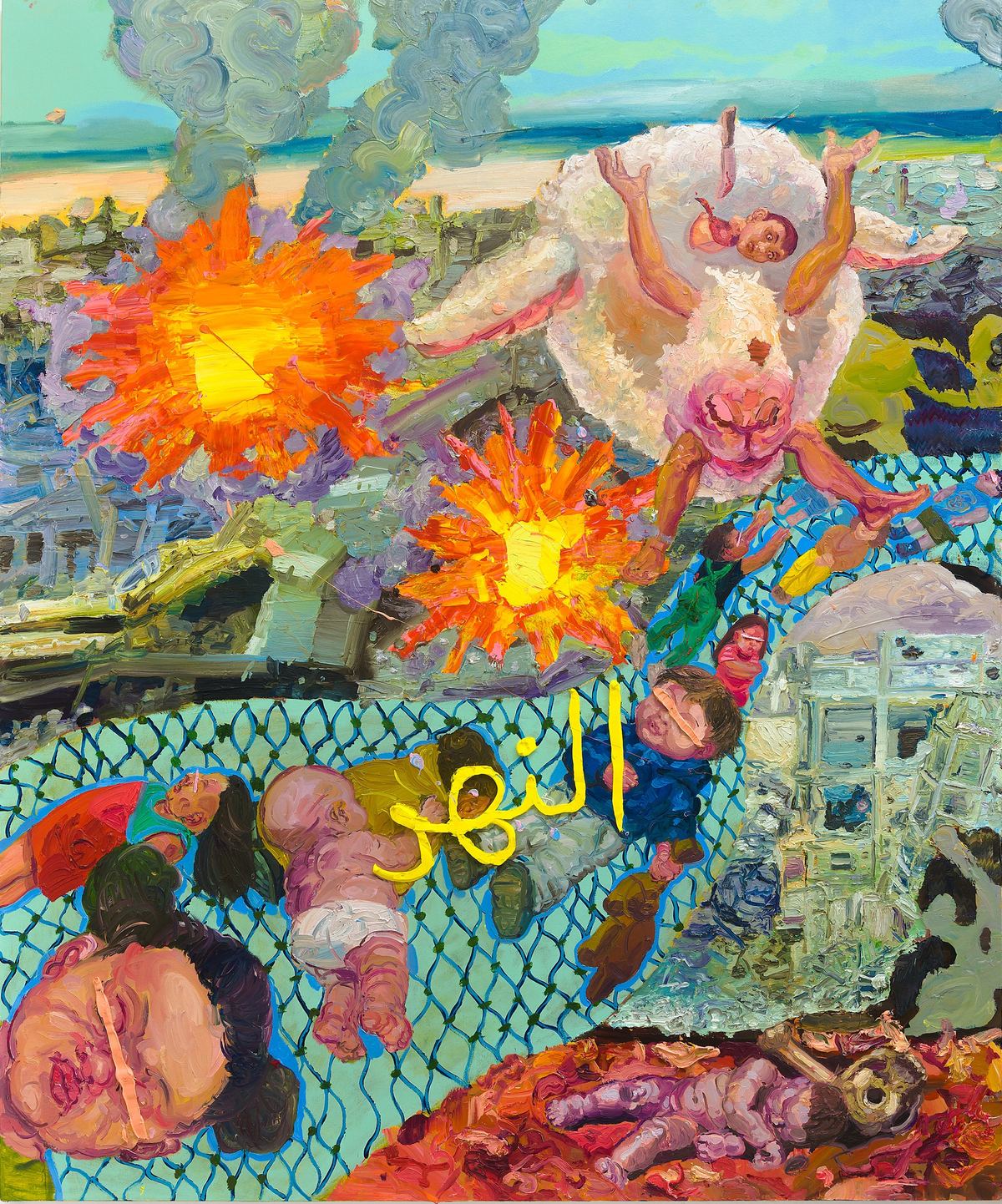
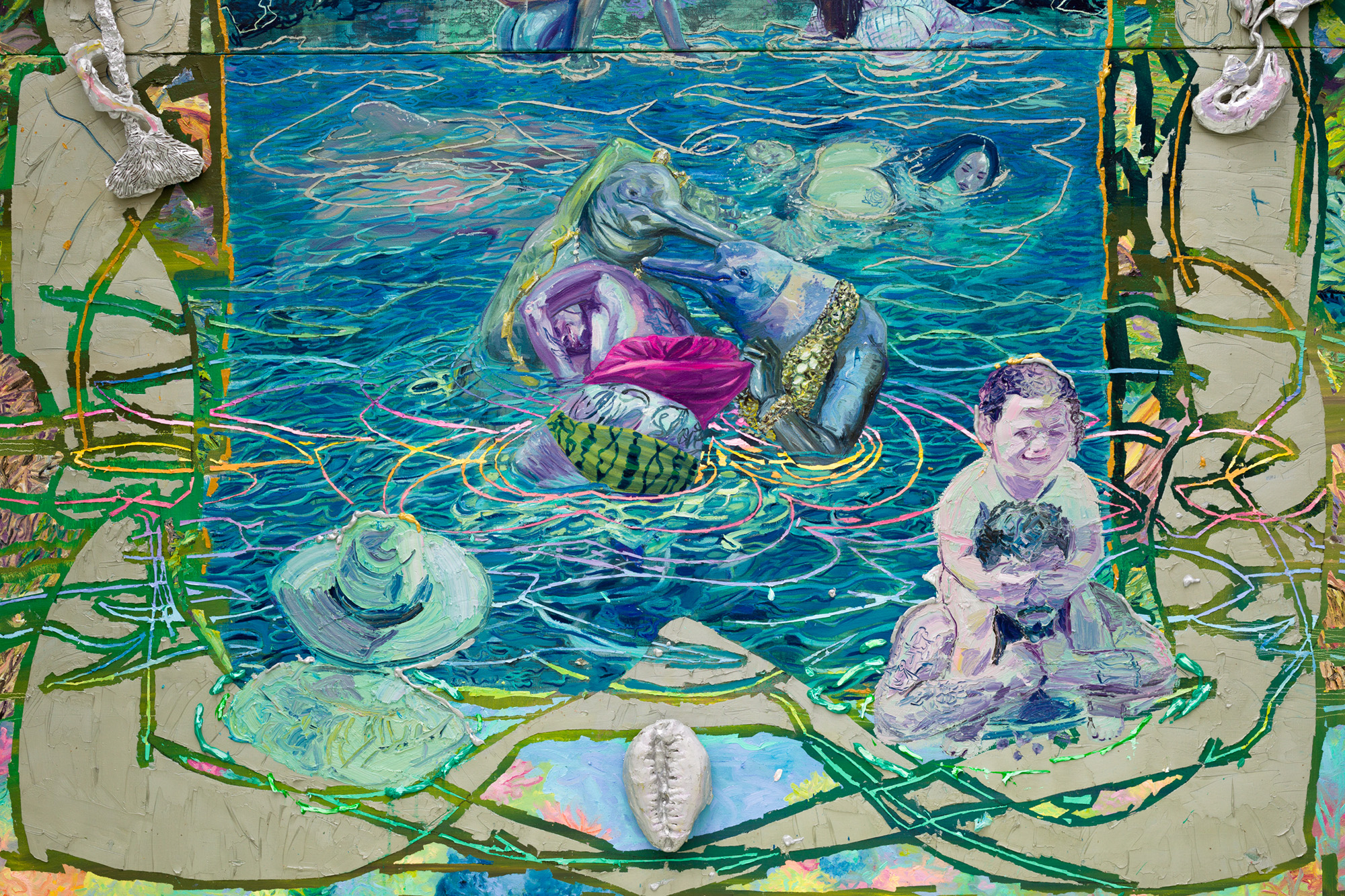
The selected works show how water and coastal territory become both witnesses and active forces. In one polyptych, a mangrove’s exposed roots occupy the center while red, almost flayed figures move across a blue shore; embedded screens interrupt the painted surface, suggesting that violence repeats through different media and times. Another scene folds human bodies, animals, shells, and hybrid presences into turquoise water so densely worked that the river seems to carry memory in its currents. A vertical composition sets flames, explosions, fishing nets, displaced bodies, and the sea within the same unstable field. Even when the imagery is brutal, Martins de Melo avoids a simple opposition between victim and perpetrator. Transformation remains possible: bodies merge with animals, spirits cross into material space, and landscape becomes a political and sacred territory rather than a passive background.
Martins de Melo’s work has circulated widely, including the 12th Lyon Biennale in 2013, the 31st São Paulo Biennial in 2014, and the 12th Dakar Biennale in 2016. Major solo exhibitions include Bárbara balaclava at Fundação Joaquim Nabuco in Recife, Necrobrasiliana at the Museu Nacional da República in Brasília, and Resistência at Fundação Iberê in Porto Alegre. His works are held by institutions such as MASP, Pinacoteca de São Paulo, MAM Rio, Pérez Art Museum Miami, ICA Miami, and the Astrup Fearnley Museum. This institutional reach has not softened the work’s confrontation with power. Martins de Melo continues to treat painting as a counter-archive: a place where erased people, suppressed cosmologies, and damaged environments return with force, demanding that Brazilian history be seen not as a settled narrative but as an unfinished field of conflict and resistance.