Set Genet and the Unruly Ecology of Desire
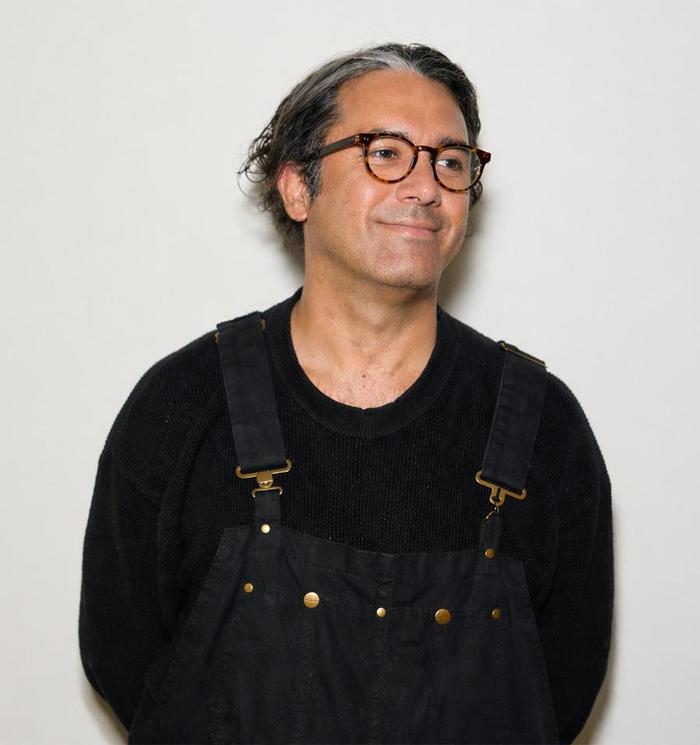
Set Genet is the artistic name through which Marcelo Reges Pereira transformed biography into a practice of reinvention. The distinction matters to the artist: Marcelo evokes an early life in Anápolis and the memory of a boy afraid of being seen, while Set claims Teresina as the place from which art became a public act of reconstruction. Before establishing this visual practice, Pereira trained in the social sciences, graduating from the Federal University of Goiás in 2000 and completing studies in Social Anthropology at the Federal University of Santa Catarina in 2004. Two decades of technical and teaching work in anthropology preceded and accompanied an artistic career that became publicly visible in Piauí through the collective exhibition Arte Alternativa, in Teresina, in 2017. See also Gabriel Archanjo and the Figure as a Field of Resistance.
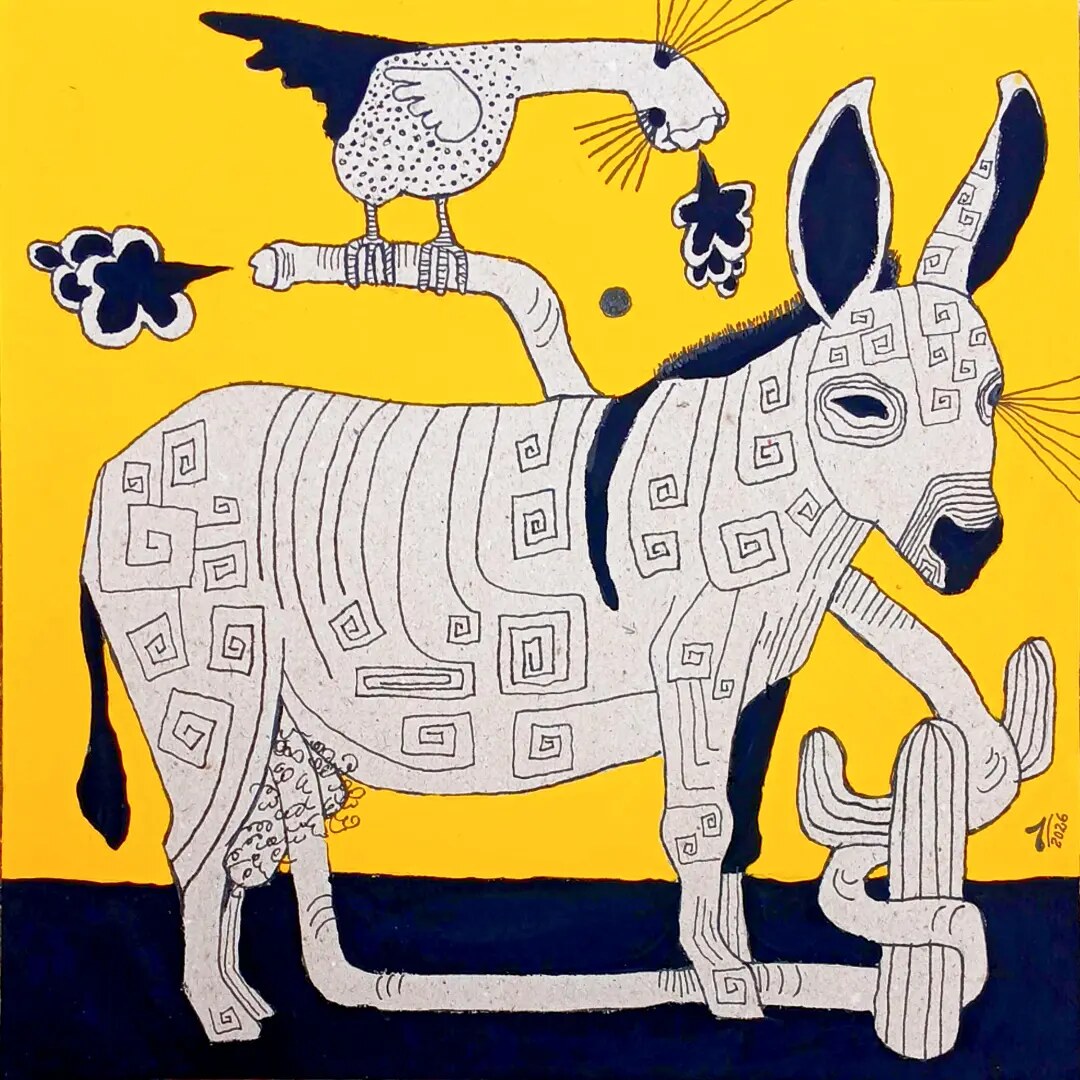
That anthropological formation does not appear in the work as academic illustration. It operates more deeply, as a refusal of rigid borders between nature and culture, instinct and social order, body and landscape. Genet describes the work as an anthropomorphization of the caatinga and cerrado: animals become people, people become animals, and sexuality moves through both as a force that unsettles supposedly stable categories. Carnaúba palms, mandacaru cacti, capybaras, xexéu birds, peripheral residents, and fantastic hybrid beings share the same visual world. This ecology is not harmonious in a sentimental sense. It is comic, erotic, aggressive, vulnerable, and continually changing, turning regional references into agents rather than decorative signs. See also Jairo Arcoverde and the Freedom of a Pictorial Alphabet.
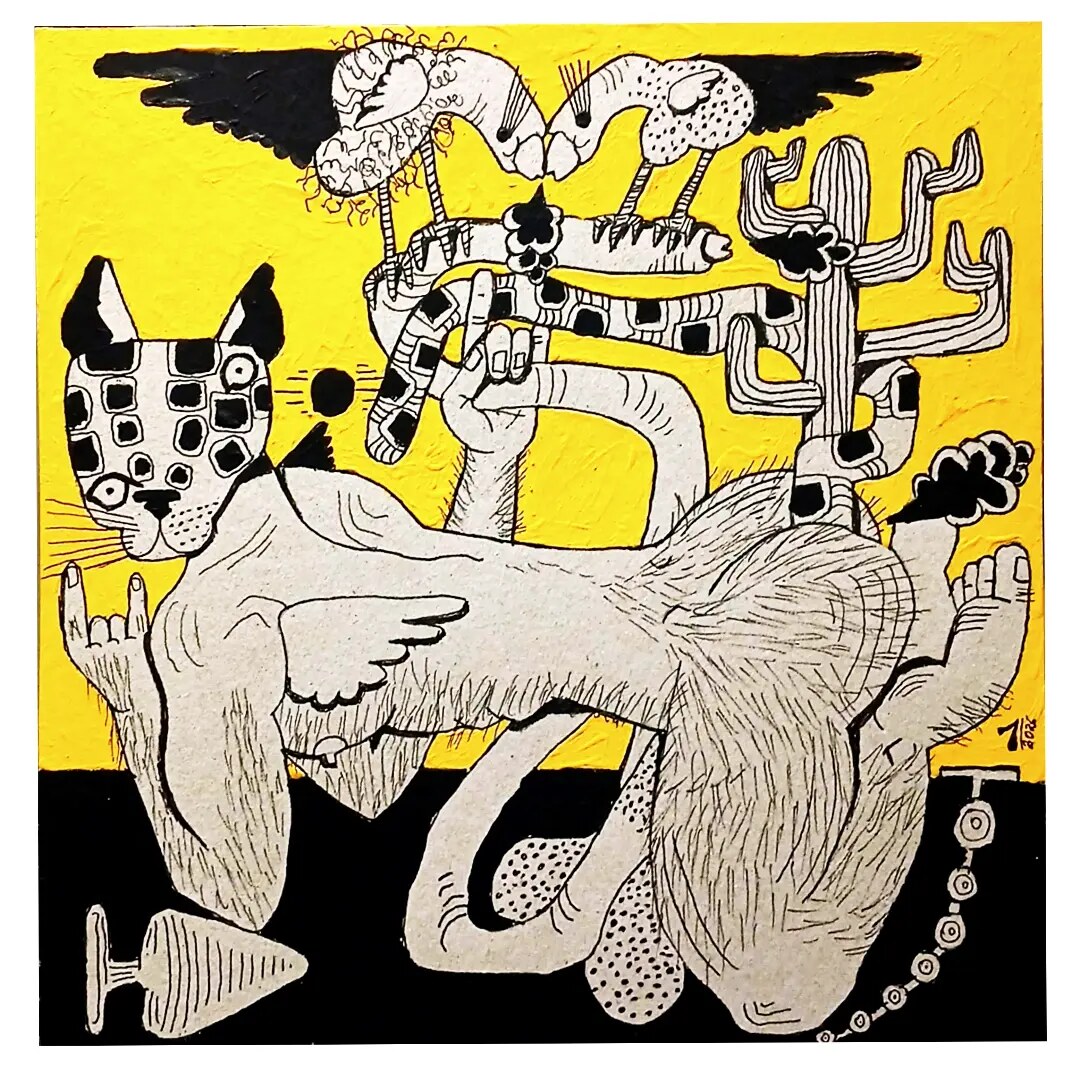
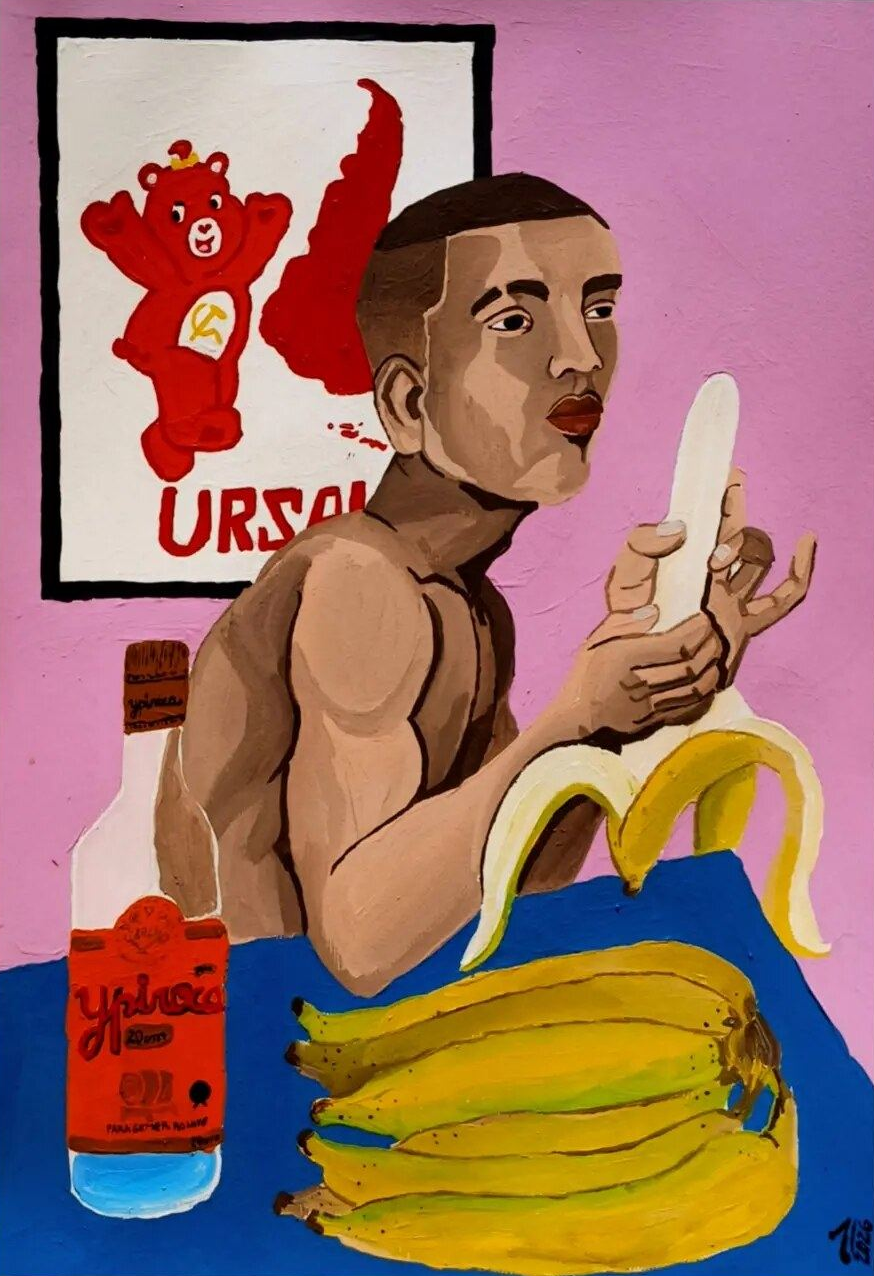
The three works selected here reveal the range of that language. Two compositions reduce the palette to yellow, black, and the pale ground of densely worked bodies. A spotted feline, a long-eared animal, birds, cacti, limbs, genital forms, and plumes of smoke overlap without submitting to ordinary anatomy or perspective. Fine hatching, spirals, stripes, dots, and abrupt black shapes make every body feel provisional, as though it could detach and recombine with the forms around it. In the third work, Genet shifts toward a more naturalistic domestic scene: a young man seated before a bunch of bananas turns an ordinary food image into an openly erotic tableau. Branded packages and a poster remain visible, placing desire inside contemporary consumer culture. Across these contrasting modes, humor becomes a critical tool. The absurd does not soften sexuality; it exposes the conventions used to regulate bodies, masculinity, appetite, and visibility.
Genet’s public trajectory reinforces this mixture of regional specificity and political urgency. The artist participated in exhibitions in Teresina, Florianópolis, and national online programs, and was selected by Itaú Cultural’s Arte como Respiro initiative in 2020 in the drawing category. In 2021, Genet received second place in the Josenildo Suassuna Prize for Naïf Art, organized by the Fundação Cultural de João Pessoa. The awarded proposal drew from Suassuna’s work while insisting on a Piauí vocabulary of local flora, fauna, and peripheral life. Yet Genet’s strongest achievement lies beyond any single stylistic category. By bringing anthropological attention into contact with queer desire, irreverence, and the visual memory of the Northeast, the work creates a world in which identity is never fixed. Every creature is capable of becoming another, and every landscape is also a body imagining its freedom.